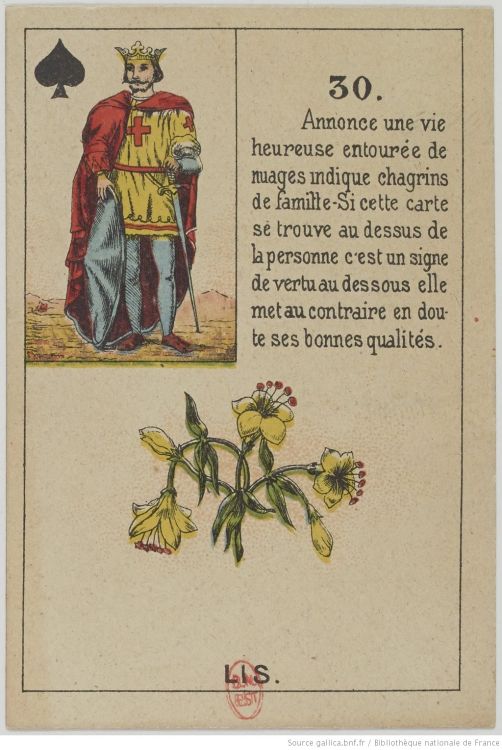
The Petit Lenormand is probably the most fascinating fortune-telling deck inherited from the 19th century. Inspired by the famous Mademoiselle Lenormand, this 36-card deck is known for its amazing ability to predict the future in a concrete and direct way. While other oracles can be vague, the Lenormand gives honest answers to daily life questions (love, work, money).
At first, it is tempting to see the Lenormand as a simpler system than the Tarot. With only 36 cards using clear symbols (a Dog, a Tree, a Key...), it seems easier to learn than the 78 complex cards of the Tarot. However, this simple look hides a clever mechanic.
To master this deck, learning keywords by heart is not enough. The real power of the Petit Lenormand lies in its unique grammar:
Download the PDF eBook version (80 pages) of this complete guide for free. Included: the 36 classic cards + the 8 bonus cards from the Gilded Reverie + thematic interpretations.
This guide was created to save you time. You will find below the full meaning of the 36 cards. For each card, I first give you the classic and traditional view (to have solid basics), followed by my modern interpretation from my personal practice, to help your readings flow better.

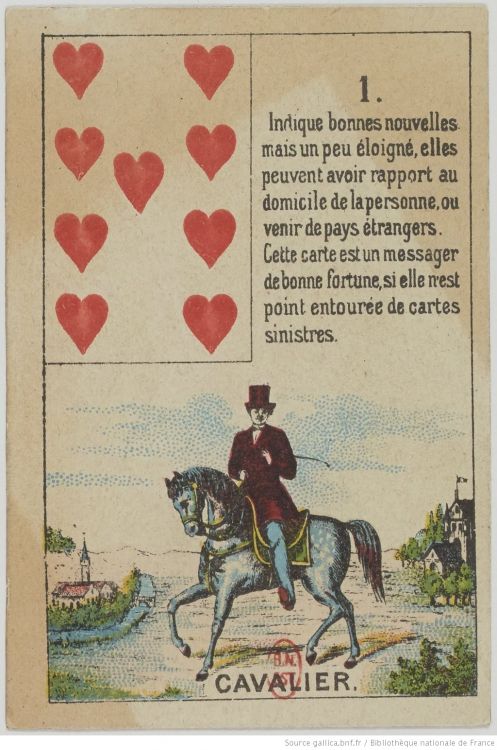
In the classical interpretation of the Lenormand, the Cavalier has several meanings : an idea for a trip. For example, a person coming to you. Or the arrival of a message or visitor (as if the rider were the letter carrier) which can extend to receiving a phone call, an email, a text message, etc.
Associated with the 9 of hearts, a card is also synonymous with joy of life and love.
The Rider is first and foremost the card of news and messages. For the European school, it is a concrete bringer of new situations, with special attention to speed and origin — often from abroad or outside the home. The Brazilian tradition sees it more as a card of movement and impulse: it embodies pioneering courage, physical vitality and the spirit of adventure, announcing arrivals — people, opportunities — that demand a quick response. For the Russian tradition, it is a card of favorable communications: messages, calls, visits. In the past position, a message already received; in the future position, hope and the solving of problems. All traditions agree on its shadow: rushing ahead, recklessness or inconsistency.
In the Gilded Lenormand, the Knight card is a woman ! In fact, the card has a positive aspect, indicating favourable communication and exchanges, where the interlocutors are open and receptive.
The horse is that of a merry-go-round, evoking nostalgia, the past of childhood, and also a form of carefreeness or happiness reinforced by the presence of the rainbow. The rainbow also symbolises hope, and the treasure that is hidden at its foot in legends (perhaps illusory).
Forget the association with the 9 of hearts, joy of life and love is the business of the 24 - Heart card.
Some cartomancers suggest that the 1 - Knight card is associated with short journeys and the 3 - The Ship card with longer journeys. Keep it simple, attach the notion of travel and journeys only to the card 3 - The Ship.
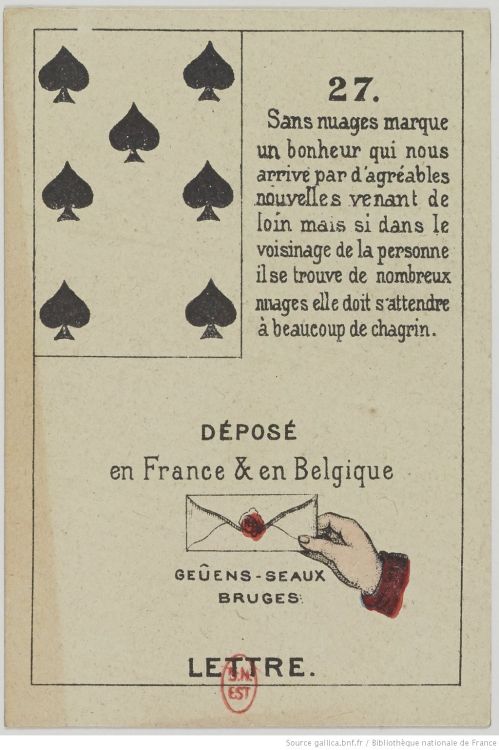
Forget the notion of receiving messages with this card, this is rather the function of card 27 - The Letter.
In the end, remember only one main idea for this card: QUICKNESS. This card speaks of a quick action, which happens quickly, which starts quickly.
This card speeds up everything it touches. Everything becomes fast. For example, with card 8 - The Coffin, the end becomes imminent and brutal. With card 22 - The Way, the decision must be made quickly. With card 12 - The Birds, a matter must be communicated as quickly as possible. And so on.
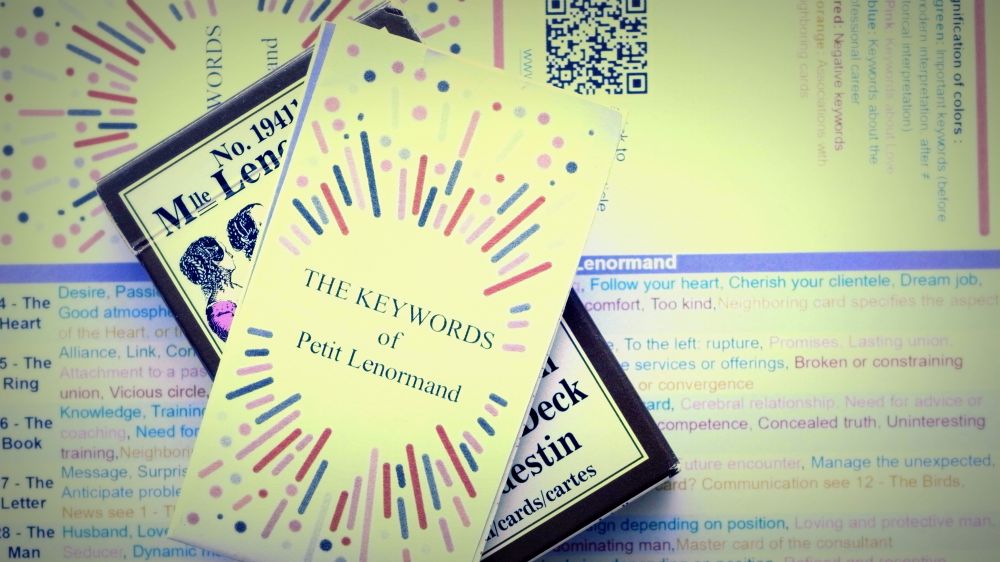
Keywords for the 36 cards of the Petit Lenormand, to slip into your favorite deck. Your leaflet always with you, at hand, to guide you in your readings. Thanks to it, your interpretations gain in richness and subtlety.

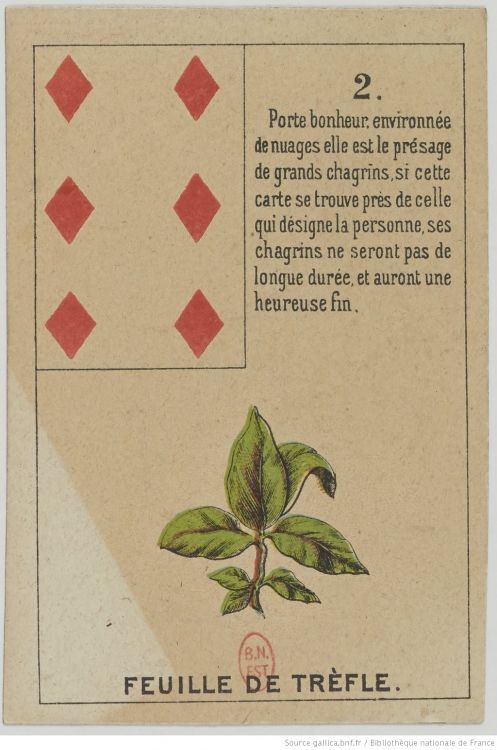
In the classic interpretation of the Lenormand, the Clover is a positive card announcing that good luck or success is on the way, which will happen even after a series of problems or setbacks. In this way, the card can act as a 'totem of protection' or, more classically, as a 'lucky charm' for the whole draw, even with the presence of negative cards nearby. The tide will eventually turn, and the troubles will eventually fade away with time.
Associated with the 6 of Diamonds, the card can also announce small profits.
The Clover is the card of luck and happy chances. The Russian tradition makes it a fundamentally kind card: happiness, good fortune, optimism, the belief that dreams will come true — while noting that negative nearby cards can turn it toward disappointment or material loss. The Brazilian tradition adds nuance: under the name Paus e Pedras, it also points to small setbacks that test patience, showing that the unexpected can be good or bad. In both cases, the card speaks of life made of fleeting moments and the passing nature of situations. Its universal message: stay flexible, keep your sense of humor and seize opportunities, even small ones, when they come.
In the Gilded Lenormand, the image shows a complete bouquet making The Clover a prosperity card, favorable to money and finances. But because happiness never comes alone (according to this card), the happiness evoked by this card also applies to the areas of love, health and work. The Gilded Lenormand Clover is THE protection card bringing luck and happiness.
The card 2 - The Clover is the card of luck, but more globally of the opportunity to be seized, don't we say 'seize your chance'. When this card comes out, the consultant is warned that he/she has a real opportunity to stand out, to succeed, and that it is up to him/her to be master of his/her life, and to transform the situation in a positive way.
This card shows that the neighboring card or cards are the key to the solution. This card emphasizes that the means are in the hands of the consultant and is shown in the nearby cards. If the cards in the draw are not favorable or do not express a means to an end, the card indicates a positive ending through a lucky chance, a 'fluke' or an unexpected but favorable situation.

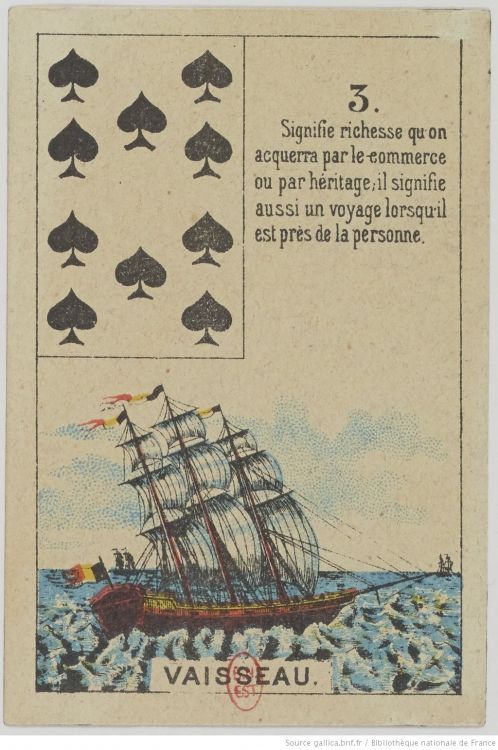
This card is usually about travel, about escape. Of course, it's not just about shipping, but often long distance travel. It's time for a new beginning, and it's an auspicious one. You can try your luck elsewhere. Much like the 2 - The Clover card, there is a great opportunity here to go.
The card is associated with the 10 of spades which is synonymous with speed (but not as fast as the 1 - The Rider card).
The Ship is unanimously the card of journey and change, but traditions differ on its nature. The European school varies by country: in France, it carries a connection to wealth and heritage linked to sea trade; in German Switzerland, it is reserved for very long journeys and distant dreams; in Anglo-Saxon tradition, it points toward personal adventure. The Brazilian tradition stresses mutually helpful exchange, gradual change and needed patience: crossing inner or outer seas takes time. The Russian tradition also connects it to the inner journey — meditation, personal growth — as well as gaining wealth. Surrounded by negative cards, it can warn of money troubles or projects moving away.
The Ship of Gilded Lenormand flies in the sky, evoking the absence of borders and the immensity of the possible paths offered to the consultant. We are invited to conquer new horizons. With its wing-like sails and its propeller, this flying ship also speaks of imagination, inventiveness and evolution.
Card 3 - The Ship can naturally speak of physical movement, but I think we really need to broaden this notion, and speak of movement in general. Indeed, the card can invite the consultant to distance him/herself from an event or a situation. The card can also speak of a newfound freedom of movement or of the need to get out of a blockage. It can be about shifting one's center of interest, that is to say nourishing new desires, seeing differently, shifting one's "spiritual" center of gravity and following new ideals. I advise you to see through this card, the opportunity to evolve, to reinvent yourself, to discover new horizons, to meet new people, to integrate other social circles.
With this card, you have to change your mind ! Literally, the Ship can 'sweep' the neighboring cards, i.e. it indicates what to move away from and distance yourself from. Alternatively, nearby cards can indicate ways to leave and change air. A juxtaposed card can also be the destination that the consultant should aim for. It is necessary to contextualize the drawing and to determine if the cards close to the Ship are its allies, its opponents, or the objective to be reached.

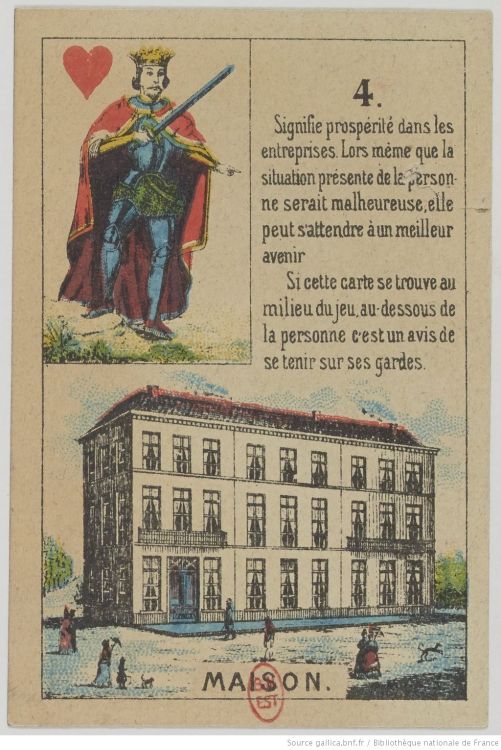
Card 4 - The House is an easy card to understand, in fact it symbolizes everything related to family and home. The card speaks of family and family ties as an anchor. It can also refer to settling down, moving into a new life, or in a very concrete way buying or renting a new place to live. In a more general way, the House can carry a dream, a hope, an ideal that can be linked to the card 3 - The Ship. In order to interpret it correctly during a drawing, it will be necessary to be interested in the cards which surround it.
The card is associated with the King of Hearts who is a benevolent character, which can represent a head of the family, a husband, a father or a grandfather.
The House is the card of foundation, safety and belonging. The Brazilian tradition reads it broadly: physical home, property, privacy, working routine, solid pillars of life — and in its shadow, stiffness, ownership or standing still. The Russian tradition shares this base but stresses the protective side: the House lessens the effect of negative cards around it and shows the importance of family values and strength. In the past position, it reveals the client's deep attachment to family; in the future position, it promises a happy home and stable family life. All traditions agree: this card invites you to grow a solid inner space, without closing yourself to change.
The House of the Gilded Lenormand takes on the appearance of a little piece of paradise. It seems to be a haven of peace, a safe place, a secure and prosperous place for one's home and loved ones. The Gilded Lenormand version does not bring anything new or original compared to the classic card. However, perhaps the House can be seen as idealized and reassuring. It invites to create a little corner of paradise and it can reflect a desire to make a 'cocoon', to redecorate its interior, to arrange a garden or even a vegetable garden, etc.
If the symbolism of the House is simple to understand, when this card appears in the drawing, it does not bring any particular clue. Indeed, family is important for everyone (or almost) and everyone wants to have a nice home. The symbolism is therefore vague and often, reading this card ends with the question "but still? So besides the fact, contextualize the House with the neighboring cards. It is necessary to systematically specify its field of interpretation, for example :
Either the neighboring cards will bring details about the consultant's 'ideal house', if this card is seen as being in the center of the drawing. Otherwise, it will indicate that a nearby card should be part of the consultant's 'ideal house'. That is, an aspect of the reading represented by a card , but considered by the reader to be peripheral or secondary, should instead be a priority or central element of his/her life. In short, the card 4 - House, radiates all around it, and brings everything that surrounds it and that is on its territory, to something central, important, necessary in order to reach a true realization or simply to feel in comfort, or in security in its life.

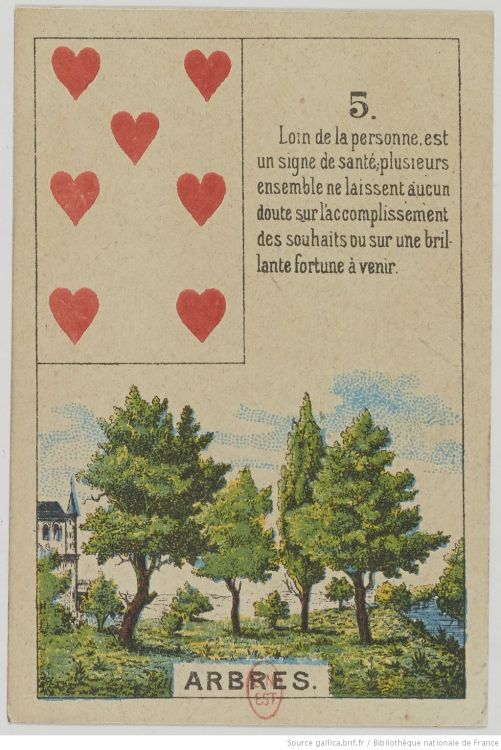
In its classical interpretation, the Tree is a card that evokes energy and health (and therefore disease). In a broader interpretation, the Tree can be a symbol of patience, fortitude, and a conquering spirit. As an aside, the card can also reflect an outdoor location, in the middle of nature.
It is associated with the 7 of hearts, a card with happy feelings and a real positive connotation.
The Tree is the card of health, slow growth and deep roots. The Brazilian tradition stresses time as a friend: nothing happens overnight, and the more time passes, the deeper strength and stability grow. It also points to its link with family history, origins and helpful energy exchange. In its shadow, it points to roots that may slow growth. The Russian tradition focuses more on personal vitality: the Tree represents a person with deep roots, able to look inward and grow personally. Surrounded by negative cards, it warns of health problems and the need for rest. All traditions agree: time is a valuable resource here, and depth comes before width.
The Gilded Lenormand version has many specific details. First the tree appears in its glory, with thick roots, strong branches, dense foliage, reinforcing the idea that the card is rather positive. We can see birds that seem to have nested in the branches of the tree, but also mushrooms at its foot. These symbols indicate that the Tree is a protective place full of vitality and spreading its energy to others. It is like a guardian. The rainbow can lead one to believe that the Tree is located in the Garden of Eden or in a pristine, peaceful and prosperous nature. Finally, the poster of the Tree of Life of the Kabbalah visible on its trunk, means that the Tree is wise, it is the heir of a lineage of knowledge.
The Gilded Lenormand Tree is therefore wise, protective, prosperous, radiant, and full of vitality.
First of all, forget the classical interpretation concerning health. Because questions about health are few and far between, and usually very tricky to answer (don't be a doctor!). In my opinion, the card 5 - The Tree can evoke the following topics :
In association with neighboring cards, the Tree can :

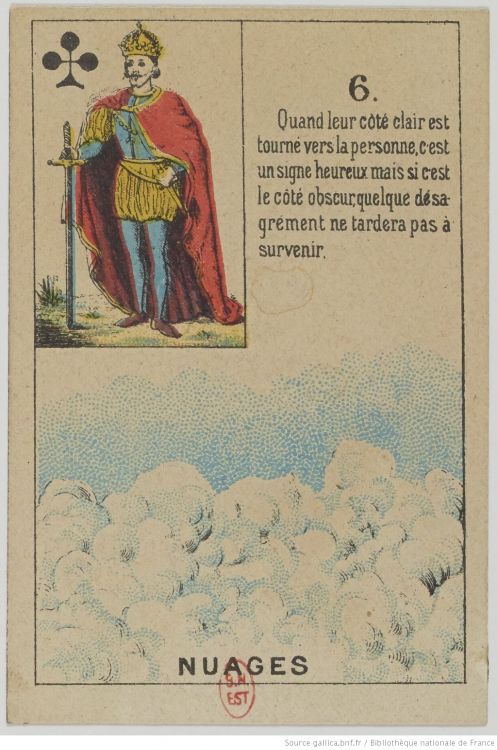
Card 6 - The Clouds speaks of a coming storm, a delicate situation that the consultant will experience or is already experiencing. If he/she already feels like he/she is being drowned in a deluge, the Clouds can predict a clearing. In addition to evoking a temporary problem, the card can also indicate that the consultant is agitated, rebellious and urges caution, lucidity.
This card is associated with the King of Clubs, a disturbing, unpredictable and austere character.
The Clouds are the card of uncertainty and confusion, but traditions measure its seriousness differently. The French school sees temporary confusion that clears quickly; the German school reads deeper doubt that may hide a real threat; the Anglo-Saxon tradition stresses mental unsteadiness and muddled thoughts. The Russian tradition gives a practical detail: if the dark side of the card points toward the client, troubles are coming; if it is the bright side, problems pass. It adds a clearing quality not found in other traditions: the trials announced can allow inner cleansing and a fresh start. The Brazilian tradition remembers that things change: like clouds in the sky, this phase is passing. All agree: do not decide while sight is unclear.
In the Gilded Lenormand, the image shows rays of sunlight breaking through the clouds, making this card less negative than in a classical interpretation. This clearing reminds us that bad weather is always fleeting. We also see birds, symbolizing freedom and flight (in the Lenormand system, the card 12 - Birds is more about communication). Finally, there is a tree, indicating that even when nature is unleashed, the tree and the forest remain a safe place. The symbol invites us to remain courageous and unperturbed in the midst of a storm.
Card 6 - The Clouds is probably one of the least interesting cards in the Lenormand system. Indeed, the consultant wants a reading because he/she has a problem, and does not know what to do, navigating in a fog. Also, the Clouds informing of a problem, a storm, a turmoil, a lack of visibility, does not teach the consultant anything. Also, you could remove this card from the deck, it wouldn't change much, except probably for the Great Lenormand Chart.
This being said, you can put aside the interpretation of the coming storm or clearing, and perhaps insist on the lack of visibility of the situation. By this, the card even means that the consultant refuses to see the truth, that he/she is voluntarily or unconsciously keeping himself/herself in the fog. There is therefore a need for introspection to seek the truth within oneself, or to listen to what people have to say. In the opposite sense, one could venture to say that someone, in the consultant's entourage, is trying to smoke him/her out, to manipulate him/her, to keep him/her in the fog.
It is obvious that the card 6 - The Clouds must be accompanied by one or more cards to be able to draw a real information. What is hidden by the Clouds can be a neighboring card. Conversely, a juxtaposed card can cause the Clouds to emerge. Ultimately, the Clouds can mean that the consultant lacks lucidity, and has a biased or truncated opinion about at least one neighboring card. Another card in the draw can also represent the means to break through the Clouds and thus shed new light on the situation.

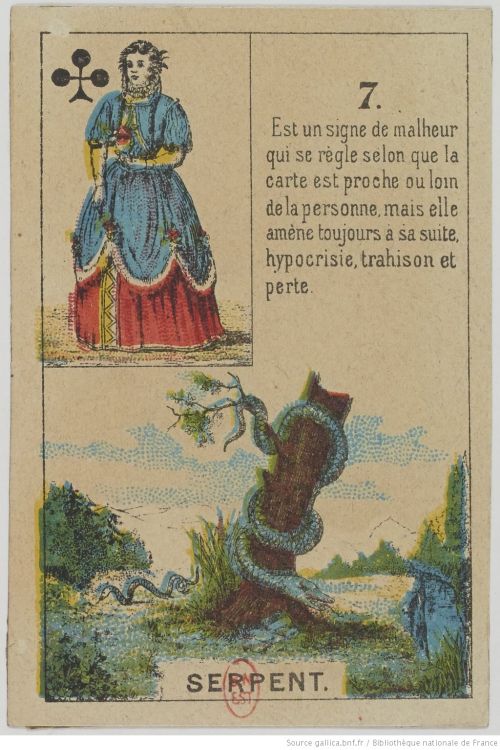
In the classic Lenormand system, the card 7 - The Snake carries a symbol of betrayal, lies and jealousy, or even cheating. Obviously this is a card with negative connotations. It speaks of betrayal in business or emotional deception, or extramarital relationships within a couple. Generally speaking, this card encourages distrust of those around you and invites you to be very careful. The Snake can also evoke a rival, a false person, and in matters of love, can represent the mistress or the lover.
The card is associated with the Queen of Clubs, seen as a deceitful and evil woman.
The Snake is the card of cunning and betrayal, but traditions add to its complexity. The Russian tradition is most direct: it warns of a false, jealous or two-faced person around you, a symbol of disloyalty and dishonest rivalry. The Brazilian tradition paints a fuller picture: patient and calculating, the Snake also shows seduction, relentless strategy and the skill to act with precision at the right time. It adds a side of change and rebirth — shedding skin to be born again — and calls for watchfulness and ethics rather than fear alone. The Russian tradition also sees possible wisdom in it, making reading more open by context. All agree: look carefully and watch before you act.
The Gilded Lenormand Snake represents a viper (not a snake) showing its fangs, about to attack. The danger seems imminent. Interestingly, the author has placed the snake in a tree and surrounded it with apples. The evocation of the original paradise, of the desire aroused by the snake in Eve, and of the fall of Eve and Adam from the Garden of Eden are obvious. Thus the Gilded Lenormand version really nuances the initial purpose of the card, by recalling the original sin, which made the first woman and the first man, mortal beings. This representation thus refers to the humanity to see the weakness that there is in each individual.
First, forget about the association with the Queen of Clubs. In fact, very few associations with the 36 cards of the classic deck make sense in the Lenormand system. Forget also the very negative aspect of the card which speaks of wickedness, betrayal, jealousy. This framework of interpretation is far from the modern divination borrowed from psychology and positive management.
For my part, I interpret the snake according to its classical and universal symbolism, which is more promising and interesting than that of the Lenormand system. Thus, in my drawings, the snake is, for me, a symbol of fertility, healing, rebirth, sexuality, clairvoyance and transformation. Indeed, throughout the world, many cultures see this animal as a powerful totem that represents the source of life. We can also see through this animal that Nature's creations are neutral. What is poisoned can be eaten, integrated and transformed into knowledge with the right state of mind. The snake's shedding of its old skin for a new one symbolizes transmutation, the manifestation of the cycle of life and death. Like the ouroboros, the ancient symbol of the snake biting its own tail in a circle.
The symbolism of the snake is therefore very vast, and seeing it only through the prism of the Lenormand system is reductive. Also, you can consider with this card :
In my opinion, the card 7 - The Snake is central in a draw. However, it covers such a vast field of interpretation, that when this card comes out, it must be systematically associated with other cards in the deck. These neighboring cards will modulate and direct the interpretation of the Snake. Thus a juxtaposed card can speak of the nature of the healing that must take place, of the true desire that the consultant nourishes, of the type of evolution that he/she must accomplish, or even where he/she must look for the truth that refuses to be found for the moment.

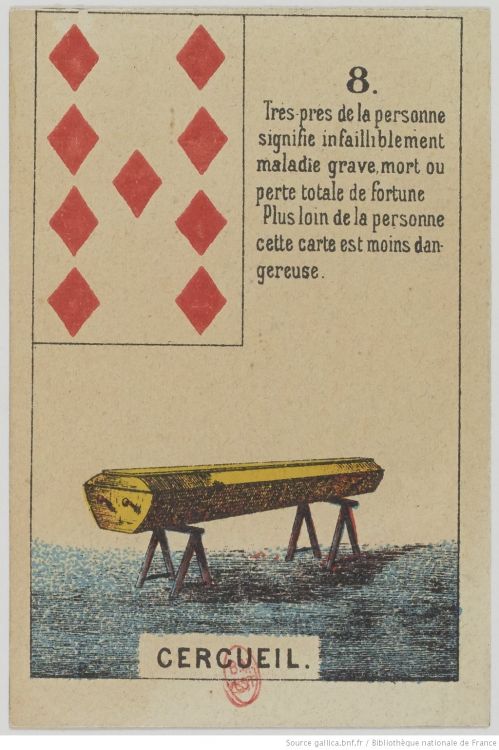
Card 8 - The Coffin announces an end in itself, not naturally a death. This end brings about a rupture, a radical change in the life of the consultant. This end can be a major financial loss, a sentimental rupture, a professional failure, an illness. This end announces a rebirth or a new beginning after the ordeals suffered. The Coffin can also be a stop, an impediment, an aborted achievement, a decline.
The Coffin is associated with the Nine of Diamonds card which speaks of delays, but also of time coming to an end.
The Coffin is the card of ending cycles and deep change. The Russian tradition links it straight to the 13th card of Tarot: unfavorable, it means illness and the end of a life phase, but can also mark passage to a new and better stage. The closer it is to the client's card, the harder the trials. The Brazilian tradition stresses the freeing side more: the Coffin shows what has lost its life force and must be let go — every end is a chance to be born again, if you accept the loss. In its shadow, traditions meet: fighting change, deep sadness, refusing to release what is done. Both see in this card a major turning point, started by crisis, and carrying promise of rebirth.
The Gilded Lenormand Coffin represents a sarcophagus and Anubis, the God of death and embalming, of mummification, in Egyptian mythology. In itself, the presence of the God does not fundamentally change the meaning of the card. It immerses the card in an atmosphere of mystery and legend. The Egyptian atmosphere of the blade, can evoke the eternal rest of the pharaoh, the life in the afterlife, and more metaphorically that life on this earth is a passage, a transition to another type of existence.
On the psychological level, the Coffin can really weigh on the consultant, living an oppressive moment, a blockage, or even a confinement. Without speaking of an abrupt end, the blade can speak of a difficult moment, where one can find oneself imprisoned, turning endlessly in an old circle, and from which it is necessary to deliver oneself, without having to sacrifice or abandon a part of oneself.
The second aspect of the card is that it can indicate to the consultant the difficulty of detaching from the situation. All things are ephemeral, and we may find it difficult to put an end to certain situations that we think are beneficial to us. This blade can speak of a kind of psychological mourning to be accomplished, in order to free oneself from one's attachment, to bounce back, to find a new momentum or balance.
This card probably deserves to be contextualized by a neighboring card that will indicate what has died, another card that will explain the nature of the link that one had with what one has just lost. Another card may also suggest a way to mourn and finally accept the situation that may be imposed on the consutant with a certain brutality. If the Coffin is perceived as a prison, a juxtaposed card may suggest a key to escape.

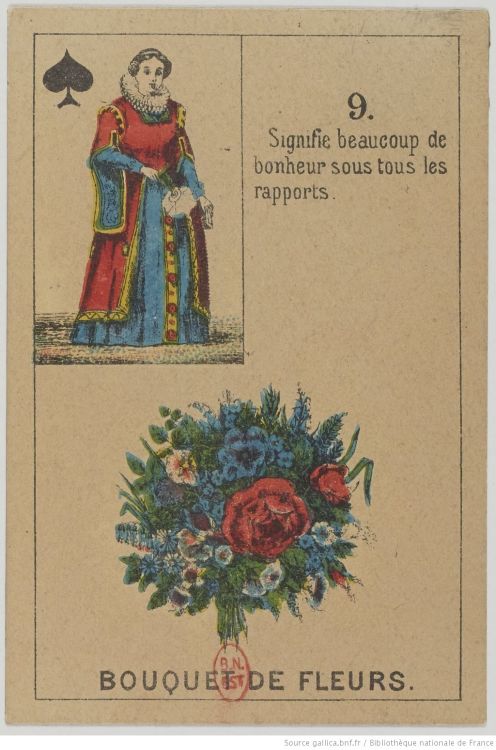
The 9 card - Bouquet can naturally presage a gift, a surprise (rather pleasant), or even a happy ending. That is, after a series of bad cards, or following an uncomfortable situation for the consultant, this card symbolizes the end of troubles, and therefore by extension, leaves room for success and fulfillment. Generally, the Bouquet is seen as one of the most positive cards in the Lenormand system. As a secondary meaning, the Bouquet can represent spring.
Associated with the Queen of Spades, the card reinforces the concrete side of the situation. Even though the Queen is a rigid, solitary character, she is nonetheless pragmatic and does not live in her dreams. She has the ability to get what she wants.
The Bouquet is the card of beauty, joy and life's gifts. The Russian tradition makes it a card of happiness and harmony: success, calm, lovely love, good mood — and it notes it is specially favorable for women. It can promise a new meeting or making up, and softens bad nearby cards. The Brazilian tradition adds to this reading: good taste, beauty, the joy of the senses, creativity and thanks — the Bouquet as a gathering of the best of each thing in one act. In its shadow, the Brazilian tradition warns against too much self-indulgence or caring too much about looks over depth. Its universal message: taste the moments of grace with sincerity and full awareness.
In the Gilded Lenormand the Bouquet is composed of red tulips and is accompanied by a message. This image is a representation of an ideal love. The tulip is also a symbol of elegance or royalty or at least an idea of luxury. Thus, this card in the Gilded, offers a very positive version, adding an idea of abundance and prosperity. The color red adds a notion of passion, ardent feelings, possibly a form of sensuality or an invitation to pleasure and enjoy life.
In the Bouquet, there is surprise, joy and satisfaction. This makes it a very positive card at first impression, but it must be qualified. First we can speak of a benevolent intention that you receive or that you have. This gesture of the heart expresses the generosity of the person. However, this intention, as sincere as it may be, may be short-lived, because we all know that a bouquet of cut flowers will fade in a few days. Also, we can appreciate the gesture but have no illusions, perhaps we can suspect a possible falseness of feelings behind this gesture that may be self-serving. In this, the Bouquet is perhaps more ambiguous or nuanced than the card 25 - The Ring which speaks of a true alliance.
But because flowers fade and a bouquet is always ephemeral, it invites to be replaced. One bouquet calls for another. So it is with love, which must be nurtured and renewed each passing day. This card can therefore speak of an attention that is given to us or that we must give, which must be durable, installed in the daily life, and which must not be transient.
Just as flowers perish, the Bouquet can be the evocation of a nostalgia, of a past joy, of a happy moment of one's life, that one regrets, that one would like to relive, that one seeks to reproduce or to renew. Just as we would secretly like to be offered a bouquet of flowers again.
The Bouquet can make the events or actions evoked by other cards seem surprising, impromptu, improvised. Likewise, these same events or actions may have no real significance, being a shot in the dark. Just as it is surprising to receive a bouquet for no particular reason and it invariably ends up in the trash. The cards in the vicinity of the bouquet can also be tempered by suggesting that the author of the bouquet may not have as benevolent, committed and profound an intention as it appears. Perhaps this Bouquet is part of a simple game of seduction revealed by the other cards. The Bouquet can emphasize a pleasant or comfortable aspect of a situation, but it can be impromptu, punctual and especially very ephemeral. The Bouquet can emphasize the real attention and vigilance of a person, but ultimately having a superficial or non-committal behavior.

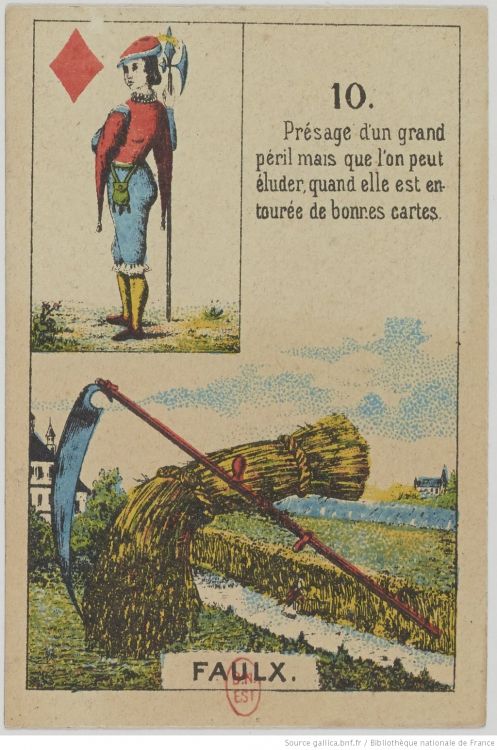
The scythe is a sharp tool, so naturally the card is synonymous with breakage, sudden end, or even injury or accident. In short, we can consider that the 10 - Scythe card is the card of danger, and that caution is required ! The Scythe can also appear with a certain suddenness, a real speed or as unexpected. But it can also mean that the consultant needs to break with an aspect of his life or needs to make a decision.
The card is associated with the Jack of Diamonds, representing a messenger, a letter carrier, a military man or a rather austere, rigid man with a cold demeanor. In fact, if the card announces news, it may seem to fall like a knife.
The Scythe is the card of sudden and unexpected cutting. The Russian tradition is direct: it warns of a hard event — accident, injury, serious illness, fierce quarrel or end of a bond — while noting it is a warning card, not fate, and that favorable nearby cards lessen its weight. The Brazilian tradition offers a more careful reading: the Scythe is the blade that cuts without feeling, tied to surgery and forced ends, but also to harvest — you reap only what you have sown. Its place next to other cards shows what will be cut or what can grow. All traditions meet on its call: act with choice and care with what must be cut or finished, without letting fear of the cut hold you still.
The Gilded Lenormand card depicts a sickle with ears of wheat and a setting sun in the background. In fact, it does not appear to be truly negative. The image suggests that it is time to harvest. The message seems clear: now is the time to reap the benefits of your efforts.
As long as one does not stop at a simplistic interpretation of the Scythe with a notion of danger, of a warning, or of a twist of fate, the blade proposes a rather broad reading grid :
If the scythe speaks of an injury, the nearby cards may well speak of the object of the injury, its origin, or the means of healing it. If it's about a decision that needs to be made, the nearby cards may specify the stakes and consequences of the decision. Otherwise, if the Scythe speaks of an expected harvest, the juxtaposed cards can speak of the positive aspects and how to take advantage of it, by what means. Finally, if the Scythe speaks of a break-up, the cards next to it can evoke what the consultant must separate from and move away from, what he/she must be wary of, or how he/she can manage to detach from the situation or the person.

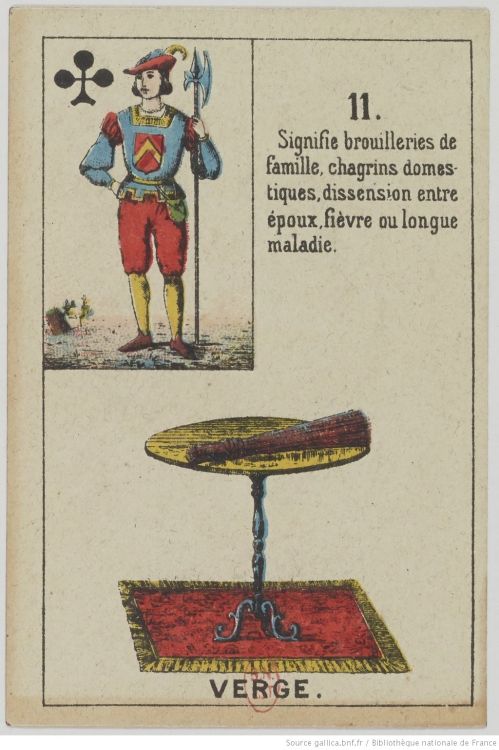
The Whip is an instrument for punishment. In all cases, this object is associated with physical violence, a painful situation, or anger. The card is a source of disputes, tensions in the close circle. It can also foretell chronic illness, aches and pains, flu or even fractures.
The blade is associated with the Jack of Clubs, usually represented as a military man or soldier. He can be seen as a fiery and reckless young man.
The Rod is the card of conflict and forcing power, but European traditions show deep differences. In France, the double meaning of the word opens toward sexuality, sport and physical activity, even strong discussions. The German school points it toward serious conflict, punishment and repeating bad patterns. The Anglo-Saxon tradition sees debate, aggressive talk and physical work. The Russian tradition is clear: important quarrels, false friendship, unhappy marriage, inner tension or trouble at work — with breaking up as the likely end of the conflict. The Brazilian tradition adds a deeper reading: ruling over others, punishment, anger in all its forms, but also, in its good side, discipline and will to guide. Its shadow warns against too much self-criticism and anger turned against oneself.
The image of the Gilded Lenormand shows a rod but also a whip. It can be concluded that the card can also evoke a feeling of intimidation or domination because animals can be trained with a whip. So it can be about relationships that are not violent or hostile, but at least tense or complicated because of a relationship of power and influence between people.
The Whip card is probably one of the least interesting cards in the Lenormand system because it offers few nuances in its interpretation. To the evocation of conflicting relationships with one's entourage, of a power game in the middle of which the consultant finds himself/herself, one can add the following interpretations :
Since the card 11 - The Whip is rather generic because it speaks of the conflict without specifying its nature, its cause, its effects. It is precisely the other cards in the draw that will allow us to explain more about the different aspects of the conflict by specifying, for example, the origins of the tensions and the different ways of calming or resolving them.

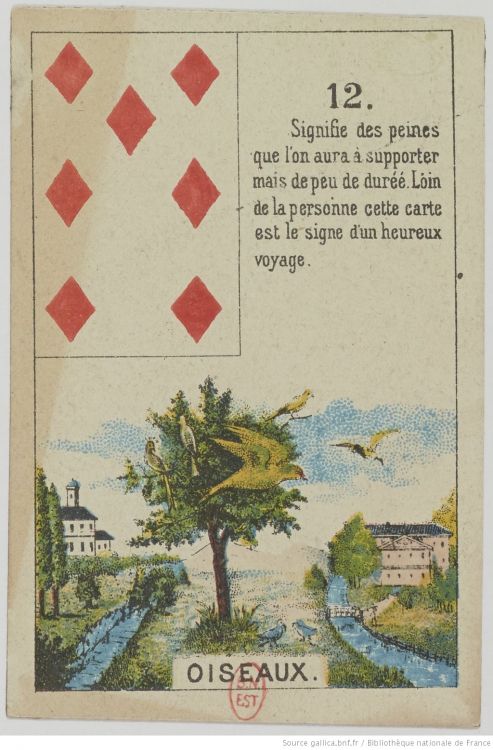
The Card 12 - The Birds evokes endless chatter, much like the chirping of birds during the day. By extension, the Birds may speak of rumours, gossip, gossip or announce news by telephone or in person, unless they bring inspiration or dreamy thoughts. The card can also announce small excursions, or a fairly short journey (in contrast to card 3 - The Ship which predicts long journeys).
This blade is associated with the 7 of diamonds, which is concerned with communication, discussions and negotiations.
The Birds are the card of talk and mental unrest, but traditions stress different sides. The Russian tradition roots them in daily life: small worries, recurring concerns, nervousness — difficulties not serious but that add up and can show sadness, doubt or health to watch. It asks for calm thought before any choice. The Brazilian tradition offers a more mixed picture: the Birds mean verbal exchange, word-of-mouth and lively talk, but also freedom, lightness and natural joy. Their unrest can bring stress and a crowded mind, but also expression and vital space. In relationships, the Brazilian tradition links them to small flirts and freedom in bonds. All traditions agree on the advice: know how to free yourself from useless weight and do not let noise take over.
There are two Number 12 cards in the Gilded Lenormand game. The first version shows a feeder and birds with different coloured plumage. One of the birds spreads its wings and flies or lands. The second version shows two owls, one perched on a branch, the other flying, under the light of the moon.
In its first version, with the feeder, the card evokes the multiplicity of opinions, as each bird has a different plumage. There may also be a need to share, and not just opinions, through the presence of the feeder which provides food for all the birds. The scene can be an allegory of a work meeting, or also of a family meal.
In the second version, the scene takes place at night, so the author wanted to evoke confidential or even secret talks and negotiations. Perhaps there is even an idea of plotting or scheming. The owls could also play the role of spies or at least have a very discreet but vigilant presence.
The classical interpretation of this card is unsatisfactory (gossip, gossip, news, travel) but revealing of another era. Because of the psychological dimension and the coaching approach of modern divination, make the Birds card the communication card.
The consultant's problem may be seen as one that can be solved through dialogue. Perhaps it is necessary to try to reconcile, or to position oneself as a mediator between two people or two camps. Otherwise, the consultant can convince those around him/her by confronting opposing views and providing strong counter-arguments.
Still in terms of communication, perhaps the consultant should talk about his/her personality, say who he/she is, what drives him/her inside, to better present his/her work. Maybe he/she needs to be more kind and friendly towards others so that those around him have a better opinion of him/her.
The Birds can also express a certain anxiety on the part of the consultant who feels nervous before an interview. Perhaps he/she is afraid of a heated exchange, of a power struggle, of negotiations that may be complicated ? Perhaps he/she is afraid of not being convincing enough ? Or simply that it is impossible for him/her to make his/her arguments heard in a hubbub, in the middle of a group.
Last but not least, the card 12 - The Birds can be a warning to listen better to others, to take their opinions into account, to be open, or to accept conciliation.
If card 12 - The Birds is about communication, then the cards next to it may talk about what is at stake in the discussion, what arguments will need to be made, what opposing arguments may be put forward. The juxtaposed cards may also indicate how best to prepare for a confrontation, or perhaps predict the outcome of the discussion. The other cards in the draw can also indicate whether a negotiation is possible, whether an agreement is possible or whether, on the contrary, the other person is sticking to his or her position.

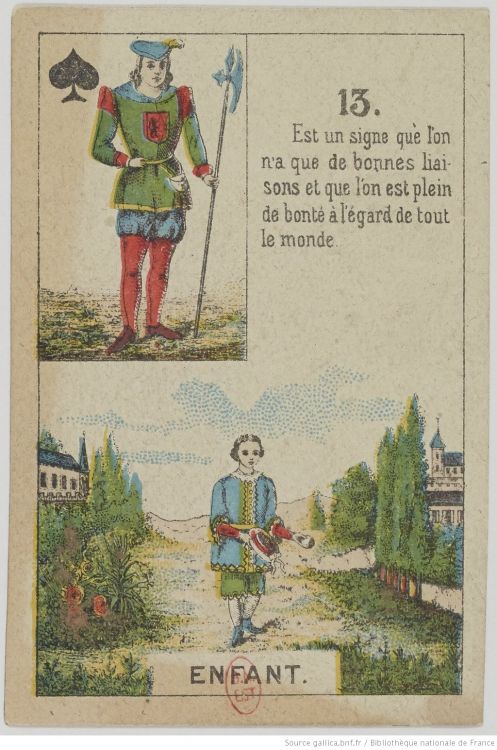
Card 13 - The Child evokes birth, a new beginning brought by confidence, hope and joy. The card represents the goodness of a person. The card also speaks of innocence, freshness, sensitivity, youth. The Child is therefore rather positive. More broadly, the card can signify the arrival of a baby in the family, or focus attention on a family problem (as would card 4 - The House).
The card is associated with the Jack of Spades who has a bad reputation, the character speaks of an encounter with someone who is bad company, selfish and deceitful.
The Child is unanimously the card of new starts, but traditions add nuance to its reach. The European school differs by country: in Germany, the card often marks a young man or shows the naive side of a situation; in France, it links more to childhood itself or projects forming; the Anglo-Saxon tradition stresses innocence and weakness. The Brazilian tradition gives the richest reading: all that is in its early stage — fragile, still green, needing care and work — including love of life, creativity, imagination and the delighted look at the world. In its shadow, it warns of naivety, immaturity and carelessness. The Russian and Brazilian traditions meet on what matters: approach new situations with openness, without bias, honoring the freshness of what is possible.
The Gilded Lenormand's Child is probably in his room, since the image shows a scene taking place indoors, with a window behind the figure. In front of the child is an open book from which emerges an imaginary castle, a rainbow, a doll or puppet, a spinning top, and dice or cubes with lettering. This illustration evokes childhood toys. It can broaden the initial meaning of the card by talking about the imagination and curiosity of children.
I don't really agree with an interpretation of a new beginning with the card 13 - Child. Because the infant in its cradle is more synonymous with birth, with departure. What's more, such an interpretation overlaps with the meaning of card 17 - The Stork which is the symbol of birth par excellence. So stay focused on the qualities of childhood, and avoid the trap of leaning towards the symbolism of the Stork. Especially as the theme of childhood is already vast enough :
Card 13 - The Child covers a vast field of interpretations that the other cards in the draw can clarify. A neighbouring card can express the quality of the Child that should be remembered: his joy (example: Bouquet), his innocence (example: Lily), etc. The card can also mean that one must look at the other cards of the draw with the eyes of a child or with a new look. Put energy where there is breathlessness, put humour where there is bad humour. The Child rejuvenates the neighbouring cards, gives them joy, energy, spontaneity. Either The Child will transfer his energy to the other cards, or The Child will become the centre of the draw, and link the neighbouring cards, just as the child makes the toys around him his own, uses them and mixes them to his taste.

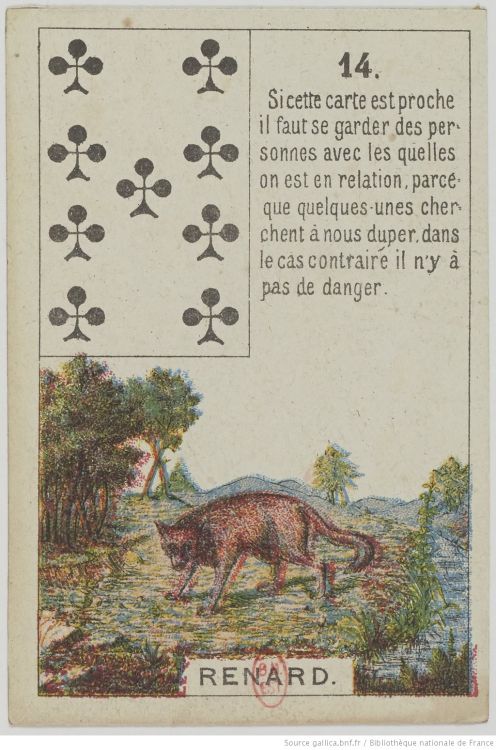
Card 14 - The Fox is the card of business, of commercial transactions, and personifies the malice and cunning that must be shown to sign juicy contracts. The Fox can also be bold and use its charm to achieve its ends. The Fox can also be one step ahead of his opponents. In a broader sense, the card is therefore related to the world of work. In the opposite direction, the Fox can become deceitful, deceptive and thieving.
The card is associated with the 9 of Clubs which, in fortune-telling, symbolises success at all costs
The Fox is one of the most different cards between traditions. The French school makes it the card of work and jobs — practical smarts put to use in career. The German school sees the opposite: trickery and hidden danger, the feeling that 'something is wrong'. The Anglo-Saxon tradition wavers between strategy, care and sometimes self-employment. The Brazilian tradition joins the non-French European reading: cunning, seduction, taking what you want, empty promise and convincing talk — smarts used for oneself, often at others' loss. It stresses though that in its light, the Fox can show wisdom and the skill to move well through hard situations. The Russian tradition confirms: trickery, hiding things, moving others. All agree on the advice: look carefully, do not trust what you see.
In the Gilded Lenormand version, the Fox is depicted in an alert posture, ready to pounce, looking back as if wary of a dog or hunter after him. Not far away, a rooster is perched on a post, possibly preying on the fox, but also indicating the need to remain vigilant and observant when the fox is prowling around. Finally, the image shows a farm in the background, which may evoke the relationship to work that the card symbolises, but also the object of the Fox's covetousness, which would seek to break into the premises.
The fox is an interesting animal because it can be seen as positive or negative, unlike the wolf which is rarely a positive symbol. However, if I like to associate the card with cunning and malice, I find it difficult to make a clear connection with business and the world of work. The fox is above all a predator, far from being a workaholic as the ant can be, and concerning business, one would see it more as a pilferer and opportunist, not as a killer like the shark.
So personally, I keep the idea of a daring, clever, cunning, undoubtedly cautious fox, ensuring its back. Of course the animal can become a real thief with deceptive stratagems.
The Fox can transmit cunning and malice to neighbouring cards. Thus, with regard to the other cards in the draw, the Fox suggests to circumvent the problem, to look at it with another eye, to seek a less dangerous, more pragmatic alternative. Alternatively, the Fox may speak of the risks involved in attempts and undertakings made through the neighbouring cards. Thus the Fox can encourage caution and distrust of neighbouring cards. In another interpretation, the Fox could be the consultant or someone close to him/her, and be like the wolf in the sheepfold or among the sheep, i.e. coveting the adjoining cards, trying to get hold of them.

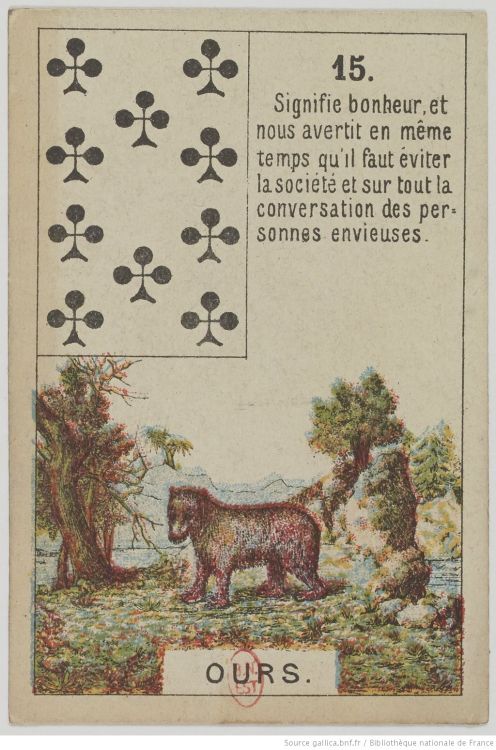
The Card 15 - The Bear is a massive and solid animal. It therefore embodies strength, stability, resistance and courage. It can be a powerful helper, and is an imposing and reassuring figure, so the card symbolises money, abundance, comfort. The classical interpretation invites to stay away from greedy and envious people. But the Bear can also be a formidable predator. It is usually difficult to escape from him !
Associated with the 10 of clubs, the Bear card is related to money, symbolising prosperous finances. This financial base can be a source of envy. The 10 of Clubs also speaks of moving.
The Bear is the card of power, but European traditions read it differently. In France, it 'weighs' with its safe: money, banking, investment, food and life force. In Germany, it 'weighs' with status: male authority, boss, powerful older man. The Anglo-Saxon tradition sees leadership, mother's care and strength of character. The Brazilian tradition goes further in showing both sides: the Bear means raw force, control and selfishness — wanting all for yourself — but also giving, wealth and the skill to gather resources. It asks you to tell apart protection from control, caring from stifling. The Russian tradition shares this both-sides view: forcing power that can protect or press down based on context, often tied to a marked power bond in the client's circle.
The Gilded Lenormand Bear is a polar bear with a white coat, making it less wild, with a form of purity. Moreover, his coat is not completely white, its colour has a green tinge, making the bear perhaps spiritual. Behind the bear, we can see ice ornaments with a transparent, crystalline appearance, amplifying the symbolism of purity.
I find it hard to associate the Bear with money, or even abundance, his great stature does not make him a symbol of profusion, on the contrary the bear hibernates and lives alone in the mountains, he is almost a hermit, at least of sobriety, little to do with abundance and money.
I don't really like the Gilded Lenormand's version of the bear, which is ultimately very beneficial and positive. Such a representation of the animal, makes it difficult to qualify, because this version does not take into account the wild side of the animal and the fact that it can be dangerous for man.
So in my interpretation of the Bear, I naturally retain the idea of its strength and resistance. In a reversed interpretation, I think the Bear symbolises risk, danger and adversity. Finally, I like the idea that the Bear can also be a symbol of solitude, of adventure through its life in the mountains, and a symbol of sobriety and withdrawal through its hibernation.
Because of its rather neutral appearance, the Bear deserves to be surrounded by cards that will suggest a direction of interpretation. The symbolism of the neighbouring cards helps to better interpret the Bear and to know if it should be perceived as a protective ally or on the contrary as a strong opponent. Conversely, the Bear can also spread its symbolism through the juxtaposed cards. He can transmit his tenfold energy, his vigour, his strength to less powerful cards. He can isolate a neighbouring card as the Bear is a solitary being. He can also hibernate the cards around him, make them less active, or delay their effects. The Bear is an imposing card in the game, for example much more so than card 14 - The Fox. So considering that the cards that touch the Bear, are in its territory, the Bear is the master.

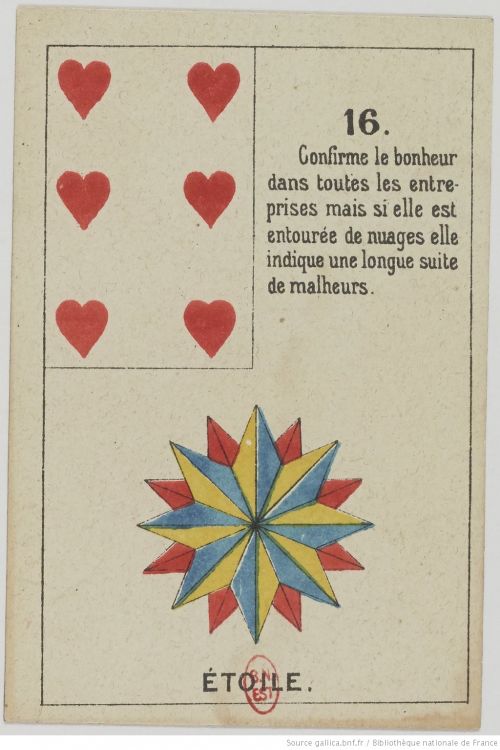
The card 16 - The Stars speaks of hope, progress and self-confidence. It is therefore generally perceived as a positive card, a good omen, bringing success when the consultant is patient and persevering. The Stars can also point to a time of calm, peace, a climate of serenity. Because the card speaks of evolution and the future, it can also be synonymous with success, social elevation and prestige. The card can however be disturbed by clouds.
The card is associated with the 6 of Hearts representing the simple pleasures of life, tenderness and memories of the past that allow for a smooth transition into one's present life.
The Star is a favorable card in all traditions, but their readings differ in depth. The Russian tradition stays practical: hope, success, clear sight, a lit path toward making wishes real — and sometimes events that stand out. The Brazilian tradition gives it a much stronger spiritual and calling side: the Star shows the forces of the world, spiritual care, the gift of feeling others' thoughts, artistic breath and link to inner guides. It shows what you were born to do and what gives life meaning. In its shadow, the Brazilian tradition warns of ideals with no roots and dreams that never come true. All traditions meet on what matters: this card shows the path is lit and asks you to follow your inner direction with trust, while keeping your feet on the ground.
The Stars of the Gilded Lenormand version are first of all a Star which takes the form of a compass. On this compass are inscribed the symbols of the 12 signs of the zodiac. The compass is in the middle of a starry sky. The central star forming the compass seems to indicate the four cardinal points, as if to trace the consultant's path towards his/her destiny, or at least to lead him/her towards the success of his/her projects.
The standard interpretation of the card seems relevant to me, except that I wouldn't let card 6 - The Clouds interfere with it. And I'm not convinced that the Stars can represent prestige in the way that, for example, card 30 - The Lily (associated with royalty) can. I like Ciro Marchetti's idea of the compass concept. Even though it is strange to have integrated a compass in this card, and to have extended the basic game with several new cards including card 42 - Compass. Doesn't this duplicate the game ?
Personally, I keep the notion of hope and progress, but also the climate of calm and serenity that the Stars convey. I also add the faith, the fervour and the multiple beliefs that are associated with the notion of hope. For it is well said to "believe in your star". Finally, the Stars could also represent dreams (always connected to hope), but also the world of the night, and the idea of a starry sky showing us a vast and even infinite universe, where everything is possible. In any case, the Stars remind us to follow our deepest convictions and be ourselves.
The Stars can transfer hope to other neighbouring cards. In this way, the actions implemented through the cards juxtaposed to the card 16 - The Stars can follow the right direction and be successful. The Stars can also soothe and calm down other cards in the draw, temporising their negative aspect. The Stars can thus say that all cards around them are possible leads, that no card should be put aside. The Stars can be a beacon in the night, a rallying point, towards which the cards in the vicinity must converge. That being said, the Star shines alone in the sky. So, if it is indeed a landmark, it may remain isolated from the other cards, remain inaccessible, like an illusory and vain dream.

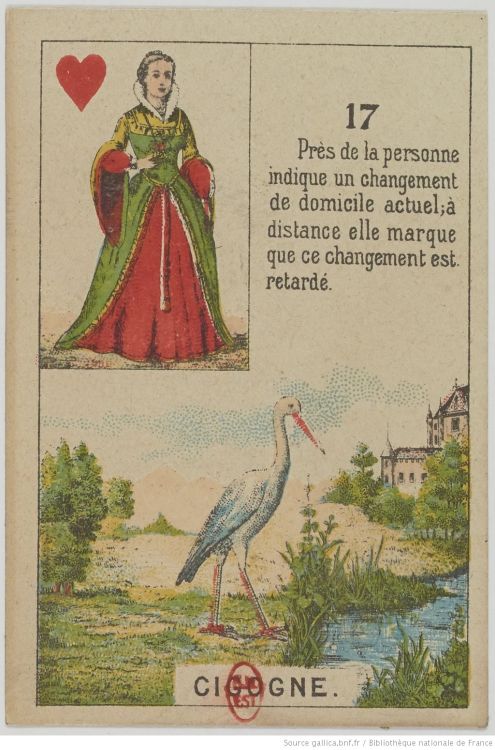
Card 17 - The Stork is synonymous with change, just as this bird migrates to new horizons. This card can therefore speak of long journeys, but also of lasting changes such as a move, or more globally, a change in the house or in daily life. Of course the card can also announce the birth of a child, so it also evokes fertility, motherhood, foresight.
The card is associated with the Queen of Hearts, representing a loyal and good advice character. It embodies confidence in those around it and in the future.
The Stork is the card of change and rebirth, and traditions agree it is good. The Russian tradition announces major shifts, usually kind or certain, showing that a new phase starts and hard times can end. It asks you to welcome change rather than fight it. The Brazilian tradition brings this reading to life with strong pictures: the end of winter and spring coming, moving from a time of want to plenty. As a bird that travels far with sure direction, the Stork also shows moving, house changes and knowing where to go and when to leave. It links to making a family bigger. In its shadow, the Brazilian tradition signals constant unrest or trouble putting down roots that last.
The Gilded Lenormand version shows a pair of storks, one of them holding a twig in its beak. The two storks are sitting on an empty nest. The sun shining behind, just above the twigs in the nest, could symbolise an egg of light. The card is about building a home.
The card has the merit of not being polarised and of being fairly neutral. The classical interpretation is in line with the symbolism of the stork. I extend the symbolism on the birth of the child to make card 17 - The Stork the card of "departure". Card 3 - The Ship, is the card of change, movement, and adventure par excellence. So with regard to the Stork, I focus not on the journey (migration) but on birth. In my interpretation of the Stork, I can talk about the arrival of a newborn of course (especially if card 13 - The Child is also present), but I will mostly talk about the need to make a new start with all the risks, the unknown factors that such a change entails.
In a sense very close to birth and fertility, generally I also make the Stork the card of creativity. Indeed, the departure that the Stork speaks of can be seen as creating change, creating a new situation, creating a new enterprise, well beyond creating through arts or crafts, which remains a valid option of course. The formula that would summarise the main idea of the card could be: "Create to make a new start".
Card 17 - The Stork can be the consequence of the neighbouring cards. Indeed, the juxtaposed cards can speak of the consultant's current situation and speak of a blocked situation in which he/she can turn in circles or feel powerless. The Stork will then invite to provoke a break with the current situation in order to make a new start and to get out of this frozen situation. In the continuity of this interpretation, other cards close to the Stork can support this new departure, and speak of the means, the tools, the objectives to be fixed in order to accomplish this rebirth.

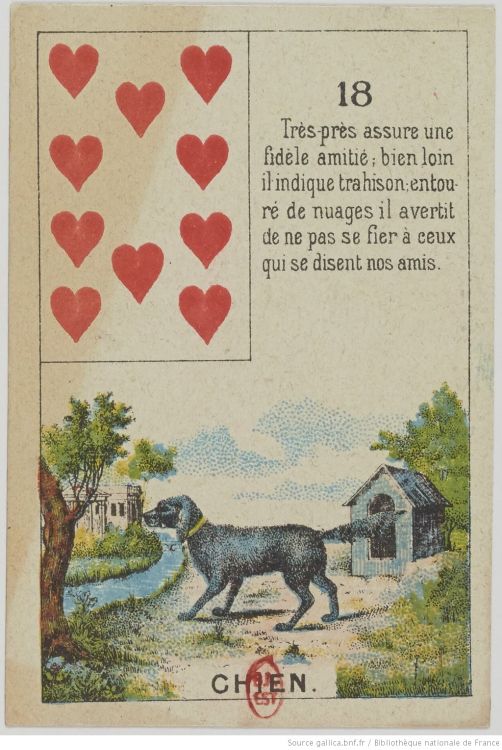
The 18 - Dog card symbolises sincere and solid relationships, where one shows fidelity, loyalty and trust towards the other. The Dog card can also evoke family reunions, outings with friends, moments shared together. The Dog can also be a symbol of protection of the home and family, just as the dog can guard the home of its masters. If the card is far away, then one should become suspicious and guard the house well.
The card is associated with the 10 of hearts, which is a lucky card in clairvoyance, capable of reversing the negative effects of nearby cards. The 10 of hearts is like a protective shield.
The Dog is the card of loyalty and true friendship, and traditions share solid common ground. The Russian tradition stresses real friends you can count on in hard times: loyalty, devotion, feeling for others and honest help. It is a reassuring card that shows the value of lasting bonds. The Brazilian tradition goes deeper: the Dog shows friendship with no limits, care that never fails and real presence that asks nothing back. It stands for both friends and work partners built on shared respect. Its joy and good mood are gifts themselves. In its shadow, the Brazilian tradition adds what the Russian tradition leaves unsaid: clinging to others, too much giving way or friends who lie about what they want. The Dog asks you to treasure true bonds and stay watchful of false loyalty.
The dog in the Gilded Lenormand version appears to be young or even a puppy. The animal is shown inside a house, with a leash in its mouth and a ball on the ground. This dog is clearly playful and wants to go outside, or at least demands attention. This is interesting because it indicates that to have a shared relationship with your dog, and to make him a loyal and faithful friend, you have to take care of him and share moments with him. This illustration is also a reminder that while friends are there to support you in difficult times, you should also share fun and festive moments with your friends.
The card 18 - Dog has an undeniable place in a divinatory system like the Lenormand. The Gilded Lenormand version also reminds us that being friends is also about celebrating together. We could also add that the dog's loyalty can also be a real devotion or even a sacrifice, for example, when it is a question of saving someone from drowning at the risk of his life. This sincerity and reliability could become a weakness, if the other used and abused it. The leash in the dog's mouth is a reminder that the dog is enslaved to its master. The card may speak of a harmful dependence on something (alcohol, drugs, etc.) or on someone. The consultant may be in a situation of control.
Finally, it should not be forgotten that the dog is an animal that has often been used by man for hunting. The dog has a good sense of smell and can follow tracks. So the card could also refer to the fact that one should lead with one's nose and not with one's logic and rationality, or perhaps that one should be on the hunt for something ? In another sense, the card may mean that one should stop hunting and stop chasing a deer that will always manage to escape. The hunt may be futile or lost.
In the first place, there is probably reason to ask what the Dog represents, an inner aspect of the consultant or a person in the consultant's entourage. The cards around the Dog may indicate to whom or what the Dog is faithful and loyal. In the cards around the Dog, look for the card that might represent the master. The cards juxtaposed with card 17 - The Dog can also evoke the needs and interests of the Dog. In another sense, the Dog could indicate that the consultant is suspicious (rightly or wrongly) of the cards in the vicinity. In this case, the 17 - The Dog card may not represent the current situation but a goal to be achieved.

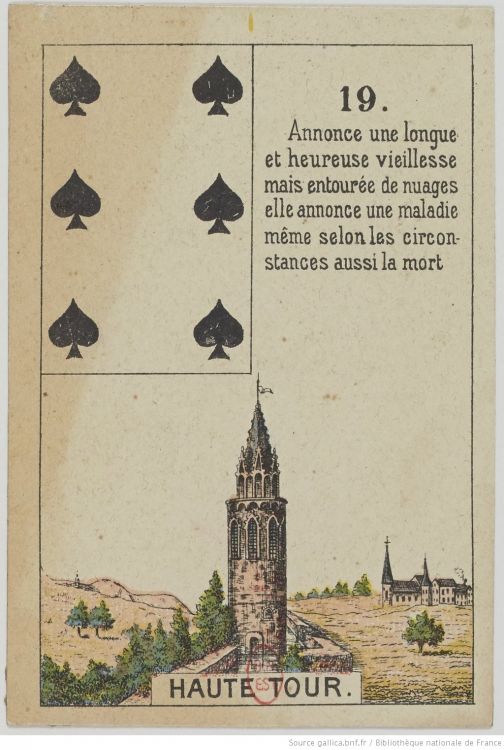
Card 19 - The High Tower is a stable and solid building that can represent buildings such as a courthouse, a prison, an administration, any institution that can embody a form of authority. If the card refers to an administration with which the consultant is confronted, the card may be synonymous with a long, tedious process, a heavy administrative burden, lengthy delays, etc. Otherwise the High Tower can represent the weight of the hierarchy, but also the ascension in this same hierarchy, whether it is professional or social. The card is sensitive to the Clouds in the vicinity, the High Tower then announces illness.
The card is associated with the 6 of Spades which means complications, disputes or danger ahead.
The High Tower is one of the cards whose meaning has shifted most between traditions. For mainland European school — France and Germany — it stays a sign of ruling power: governments, offices, big business, schools, law questions. The Anglo-Saxon tradition, shaped by Tarot, has swung it toward being alone, loneliness, ego and pulling away into yourself. The Brazilian tradition brings both together: the Tower shows both needed stepping back and thinking deeply, and also official ruling bodies, governments and those in power. From its high walls, it gives a broad and lifted view of the world. The Russian tradition backs this two-way reading: pulling apart and loneliness on one hand, dealing with official power structures on the other. In its shadow, all traditions agree: rigidity, cold feeling and too much time alone.
The Gilded Lenormand version does not show a single tower, but rather three large towers in the middle of lush vegetation, as if these three towers were part of a long abandoned site only accessible to brave explorers. These buildings, with their spires rising to the sky, seem to be religious buildings or royal residences. This illustration suggests that the High Tower is not an easy place to conquer.
The classical interpretation is convincing, but we can add a few more nuances :
The first question to ask when the High Tower is present in the draw is who lives on its top floor? A nearby card may be the answer. The High Tower can also impose its power and influence on the cards around it and dominate them. The neighboring cards can also represent means, tools to storm the High Tower and conquer it. In a contrary meaning, the High Tower could be seen as a fortress protecting the neighboring cards from its authority and strengthening them with its stability and solidity. In most draws, the High Tower is likely to be at the center of the interpretation, radiating out in some way to the neighboring cards. If the High Tower is not physically positioned at the center of the cards (which is likely), one must try to understand why the High Tower is far from its center of gravity, why it is off center. Unless it is some sort of isolated hermitage in a corner, on the periphery of the draw.

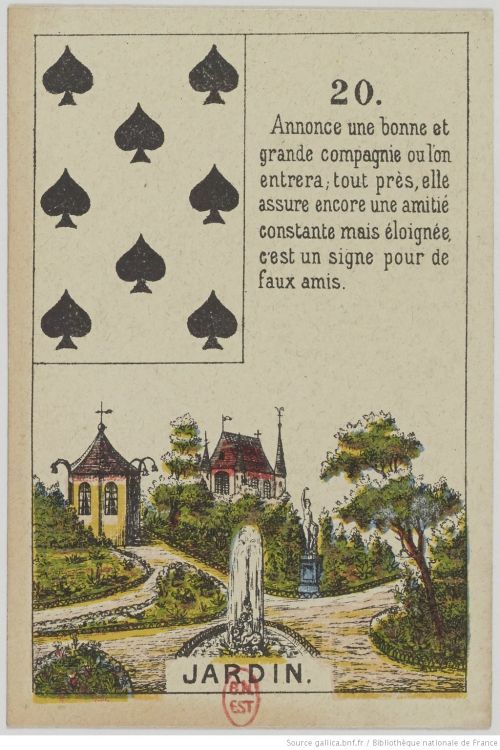
Card 20 - The Garden evokes new encounters, walking, entertainment, parties, relaxation or outdoor activities. This card also speaks of fame, social success, especially through professional development. The Garden is therefore linked to all social and public relations. The card can therefore represent friends, family, work colleagues. The card can also symbolize the arts, cultural activities, all activities that take place in meetings. The standard interpretation also speaks of a faithful friendship that becomes false when the card is distanced.
This card is associated with the 8 of Spades symbolizes sorrow, pain, and disappointment.
The Garden is the card of social life and meeting others, and traditions share common ground. The Russian tradition reads it straight: your circle of friends, gatherings, friendly people, life together and opening to the world — while noting this circle can be helpful or have bad influence based on what is around. The Brazilian tradition builds a richer and more careful vision: the Garden means public spaces for rest and bond — parties, parks, groups of like minds, online networks — as well as art, music and fun. It shows being seen and seeing others, and asks you to think about the place where you spend time: does it help you grow? In its shadow, the Brazilian tradition adds what the Russian tradition leaves unspoken: surface talk, gossip and showing too much. All traditions ask you to grow true bonds.
The card of the Garden of Gilded Lenormand is quite complete as in the foreground there is a fountain with a water jet, behind a staircase leads to a canopy. A peacock is placed on the steps. Finally, a large tropical plant is enthroned in the middle of the canopy. The image seems to be the representation of the Garden of Eden, with a paradisiacal aspect. The place seems peaceful, conducive to rest, pleasant moments, positive meetings.
Personally, through card 20 - The Garden, I put little emphasis on the notion of distraction and walking. I make the Garden the "sociability" card of the Lenormand system, and I focus on social relations. I therefore take into account the classical interpretation concerning social elevation, the search for prestige and comfort, and everything related to the arts and culture. I can also associate artistic creativity.
Without a doubt, the first question when it comes to interpreting the card is what aspect the Garden is talking about within the draw. Fame, social relationships, the arts, etc.? The cards next to the Garden may indicate what the Garden is referring to. Alternatively, the card may also indicate that you need to use your social network to achieve your goals. Indeed, the Garden can connect the cards around it, facilitating exchanges, sharing the same goals, the same means. Within a drawing, the Garden card can be seen as a kind of market place, an Agora, where neighboring cards will exchange values and qualities with each other, responding to each other.

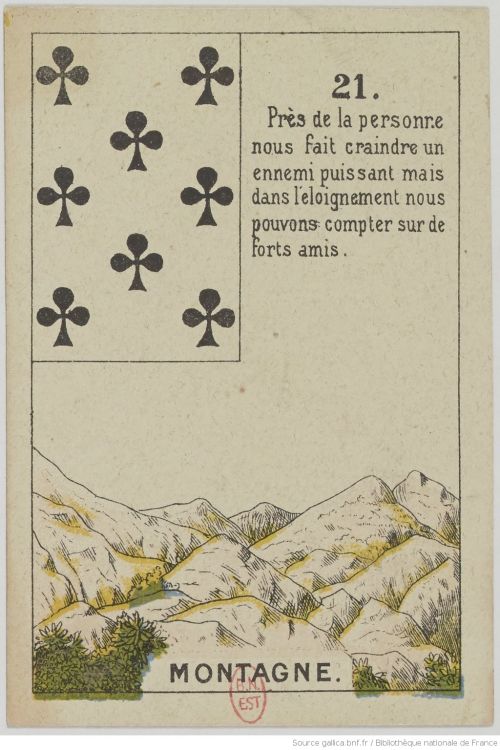
Card 21 - The Mountain portends obstacles, pitfalls, delays. Even more widely, the card foretells the arrival of enemies, annihilation, leading to discouragement, moral and physical exhaustion. In short, the problem seems insurmountable, just like the mountain. However, if the card is far away, you will get friendly help.
This card is associated with the 8 of Clubs and speaks of a success after many difficulties, it speaks of an inner fulfillment after a path of trials.
The Mountain is the card of barriers and being stuck, and traditions agree on the core while each adds its own touch. The Russian tradition describes a heavy and fixed reality: lasting obstacles, blame, heavy burdens that slow or stop the client. It asks for patience and not giving up when trials add up, though it does not explore the changing side. The Brazilian tradition goes further: the Mountain stands as a major force that pushes a person to their own limits and asks for their best. It shows differences that cannot be resolved, rigidity and powerful people in the way, but also, in its light, the ability to bounce back, inner force and wisdom gained by overcoming trials. For the Brazilian tradition, each challenge beaten opens a wider view — a rise missing from the Russian reading.
The Gilded Lenormand version shows a mountain with a snowy peak, obviously inaccessible. A dense forest extends at the foot of the relief. A deer appears in the foreground. The animal shows that finally one can conquer such a territory. The image can also give a feeling of escape.
The card 21 - The Mountain in its classical interpretation appears really negative, and does not suggest any solution. The only real way out is to consider this card as the "detour" card of the Lenormand system. Namely, that the mountain is impassable, and that one is forced to go around the obstacle and take another path. In itself, the card does not teach us much, but it can sound like an alert for the consultant who may need such a strong sign to question himself/herself and accept to look for another solution to reach his/her goals. This card can therefore be a useful warning in the face of real obstinacy.
In a broader interpretation, if the consultant is not faced with any insurmountable obstacle, the card can evoke the search for a contact with Nature, a form of return to one's roots, the desire to go back to nature. The Mountain rather than representing an insurmountable obstacle, can be seen as a virgin territory, not conquered by Man, where Nature has kept its full rights and remains wild.
To another extent, the card can be perceived as the need to take up a challenge, to seek strong sensations, to test oneself, to find oneself even, to seek one's limits. The Mountain can be an encouragement to surpass oneself.
If the Mountain is an obstacle in a draw, then try to find an alternative path or other ways around the obstacle in the surrounding cards. The Mountain can also evoke a territory to be conquered and the surrounding cards can show the means to achieve this. If the Mountain is an invitation to commit oneself and to go beyond one's capacities, the juxtaposed cards can indicate the objective and explain the necessity.

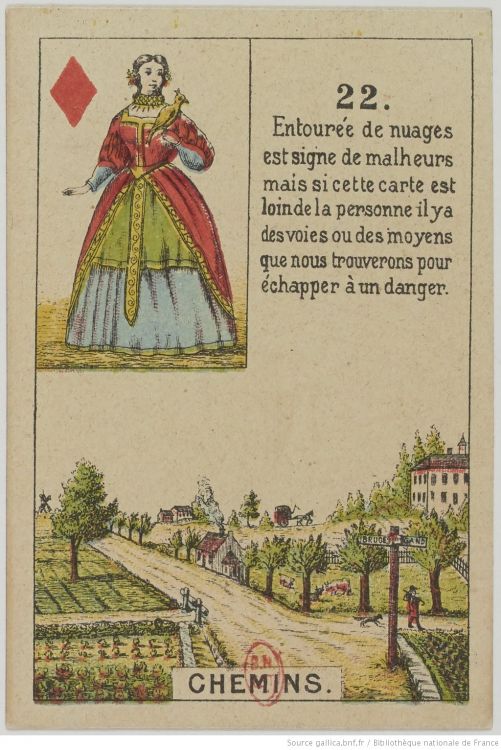
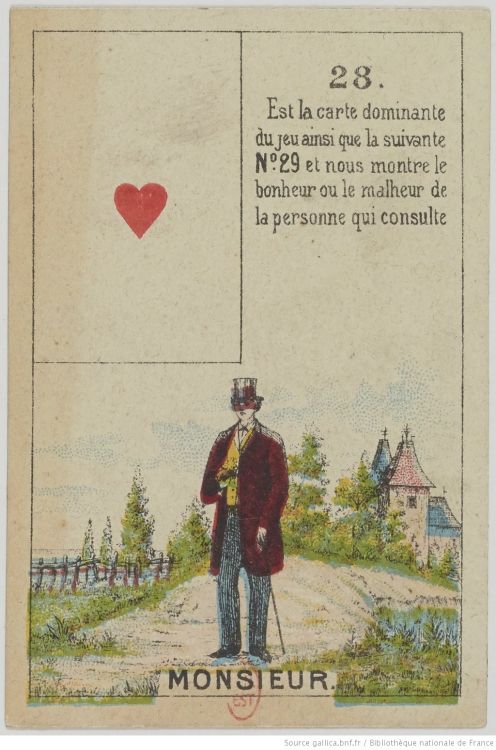
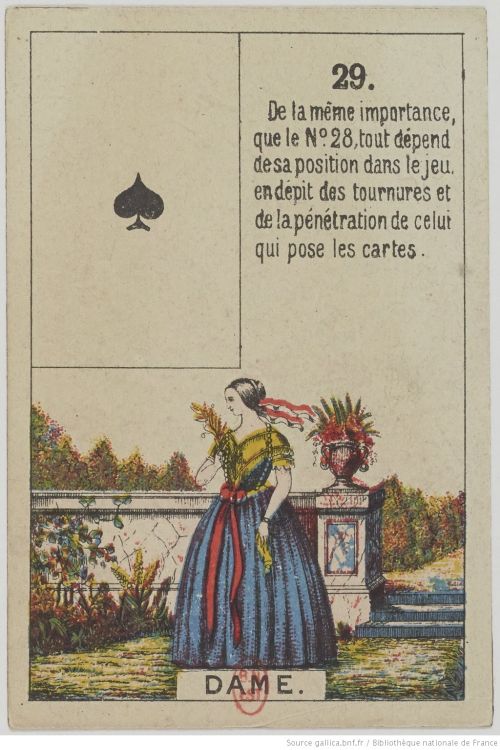
Card 22 - The Crossroads can symbolize travel by train or by road, but it especially evokes the idea that the consultant is at a crossroads in his/her life. He/she can therefore experience doubts, uncertainties, hesitations as to which path to take. There is thus a choice to be made, a decision to be taken which can become a dilemma. This decision can lead to a break, a rupture if the path that the consultant follows is a turning point in his/her life. In the strict interpretation, if the Way are close to the Clouds, they announce a misfortune, but if the card is far from the Significator (card 28 - Man or 29 - Woman) then a solution (alternative path) is possible.
The card is associated with the Queen of Diamonds who is a totally free and independent character.
The Path is the card of choices and crossroads, and traditions agree on this base, each adding to it in their own way. The Russian tradition clearly finds the situation: the client faces an important choice, or new options open up. It also knows a darker reading is possible — a situation with no clear way out or changes that must come. The Brazilian tradition builds a fuller thinking on choice: what you lose shows what you gain, and nothing is forever — if one path does not fit, you can always go back and choose again. It stresses personal duty: not to choose is also a choice. In its shadow, the Brazilian tradition points to waiting and delay, two pitfalls the Russian tradition leaves unsaid.
The illustration of the Gilded Lenormand shows a staircase covered with a red carpet, which splits in two towards two windows. The left window looks out on a yellow sky as if at dawn, while the right window shows a blue sky with some clouds. The railings on each side of the staircase seem to form a V or even a heart.
The Gilded Lenormand card seems to suggest that while the possible paths are different, they both seem valid. The image illustrates that there is no one choice that is better than another, or in other words, there is no wrong way or right way. The saying goes "all roads lead to Rome".
In addition to the standard interpretation, the following nuances can be added :
Of course, the cards next to the Way can indicate the possibilities available to the consultant. The nearby cards can also be arguments or elements to consider, either in favor or against one of the possibilities. One of the juxtaposed cards may emphasize the need to make a decision quickly. Or, on the contrary, a card around the Way may signal that there is no urgency to make the decision. Card 22 - The Way can also transfer the choice to be made to one of the neighboring cards, suggesting that there is a decision to be made in the area of the receiving card.

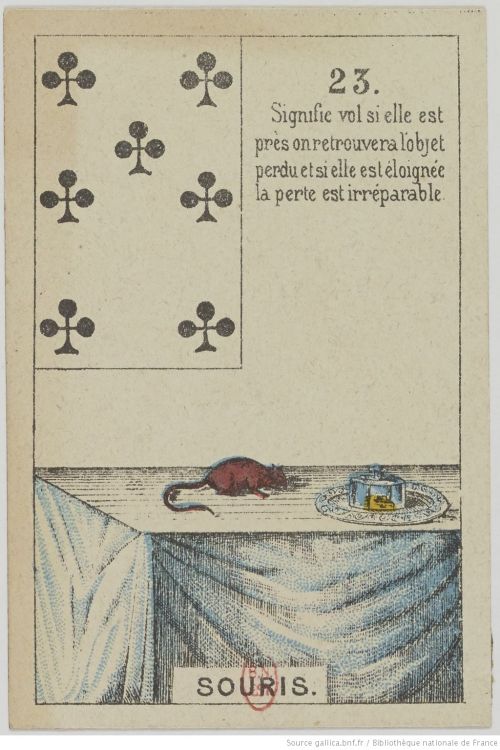
Card 23 - The Mice can foretell small losses of money, thefts by profiteers or escapes by malicious persons. All of these are reminiscent of how mice get into homes to gnaw or nibble away at supplies. This without being noticed. Mice are also synonymous with problems that are invisible or painless at first, but become important as time goes by. Thus the card can speak of stress or fear of a situation getting worse. The mouse is also a fearful animal that can succumb to severe stress. If the card is close, the lost object can be found, but if it is far away, the loss is irreparable.
The card is associated with the 7 of clubs evoking anxiety, doubt and questioning about the future.
The Mouse is the card of loss that happens quietly and bit by bit, and traditions share the same basic finding. The Russian tradition is direct: slow loss, theft, material decay and worries that gnaw — a situation, health or bond getting worse slowly. It is a warning card. The Brazilian tradition greatly adds to this picture: the Mouse works in shadow, out of sight, showing all that slips away little by little without notice — like the faults that eat at us. It adds the side of spreading harm, uncleanliness and concerns that drain energy over time. It also says losses can be stuff, feelings or physical. In its light — unique to the Brazilian tradition —, the Mouse can push you to find what gnaws and remove it before it is too late. All traditions agree: stay alert and take action early.
The Gilded Lenormand version features 5 mice. One, an acrobat, is clinging to a string, his paws in the air. A second is resting on a loaf of bread, a third is sniffing. In the background of the image, the last two mice seem to be exploring the place. There are nibbles of fruit, bread, a pot and a pitcher in the background. The author gives a vision that conforms to the standard interpretation, without adding other points of view.
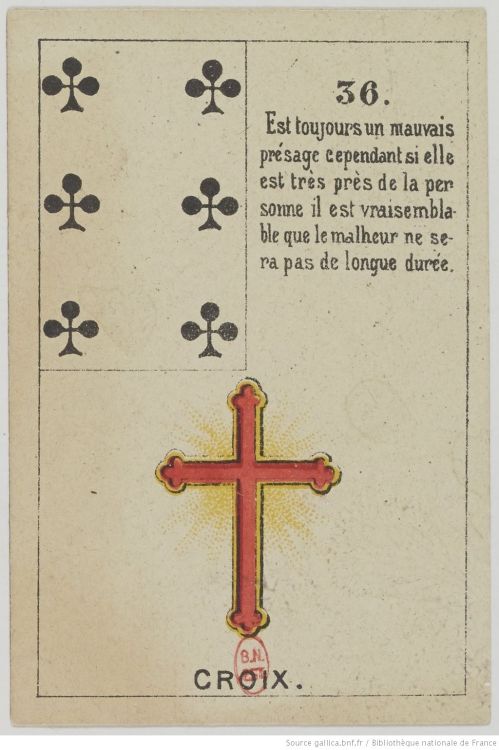
As it is, the card 23 - The Mice is not very interesting. It evokes small losses that can only occasionally be associated with the consultant's situation. Concerning stress, other cards of the Lenormand system speak of it in a more precise and tangible way, such as 8 - The Coffin, 10 - The Scythe, 21 - The Mountain, 36 - The Cross. If the consultant asks for a reading, it is because he/she is experiencing an uncomfortable situation. So talking to him/her about stress, even on a daily basis, does not teach him/her anything as such. Also, it seems judicious to go well beyond the standard interpretation, by following for example the following perspectives:
If we keep the classical interpretation, the nearby cards may indicate what losses are caused by the Mice, or what are the origins of the stress experienced. If one is interested in the extended interpretation, the nearby cards could evoke the details on which one must focus. Alternatively, the consultant may need to rationalize and economize in areas expressed by the nearby cards. Finally, one of the juxtaposed cards could represent a predator or a danger from which the consultant should cautiously move away.

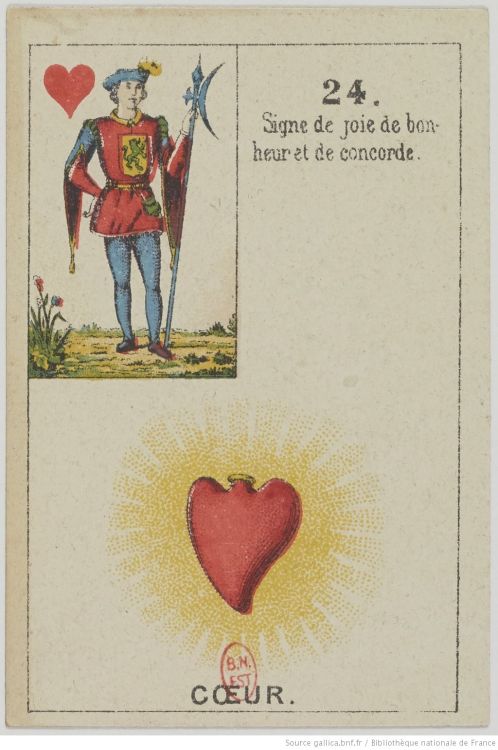
Card 24 - The Heart is naturally the card of love or friendship. The Heart eases tensions, indicates that sharing and harmony reign in the life of the consultant. Love is lasting, the atmosphere at work is good, finances are healthy. If the card represents a person, he or she is sincere, generous and honest in their feelings.
The card is associated with the Jack of Hearts, it represents a man in love or a good friend or loved one.
The Heart is the card of love and feelings, and traditions share a common positive base. The Russian tradition gives a clean reading: loving feelings, fondness, gentleness, human warmth — a satisfying love bond or deep friendship. It is a basically good card that shows what is felt truly and what binds people together. The Brazilian tradition goes deeper, giving it a broader and more mixed meaning: the Heart shows all true feelings — love, joy, sadness — and how you link to the world through emotional bonds. It means giving without thought of gain, romance, faithful care and strong feeling. Through it life gains meaning and fullness. In its shadow, the Brazilian tradition adds a warning missing from the Russian reading: too much sentiment, making something ideal that is not, or not loving yourself.
The Lenormand gilded version shows two white swans, with a heart in the center with golden ornaments, and in the background a baroque, majestic and luxurious decoration. The two birds symbolize purity and nobility.
With a symbol like the heart, it is difficult to be more explicit. The panel of qualities associated with the heart is also wide. We can speak of course of romance, true love, fidelity, but also passionate desire or physical attraction. This rich symbol can also speak of generosity, kindness, benevolence and even forgiveness. The difficulty of interpretation is undoubtedly to specify the central quality that must be retained in the context of the consultant.
The Heart will have a tendency to focus the reading on emotions and feelings. If the reading is not about love, but other aspects such as work, the card indicates that you should do things from your heart, at least follow your feelings or intuition. The means to do this can be shown by the cards surrounding the Heart. But those same cards surrounding the Heart can also point to obstacles that get in the way. If the reading is about love, the Heart confirms the importance of the subject to the querent. The Heart may naturally be very supportive of the romance, but beware of an unbalanced positive opinion. The Heart's neighboring cards should temper its unfailing positivism.

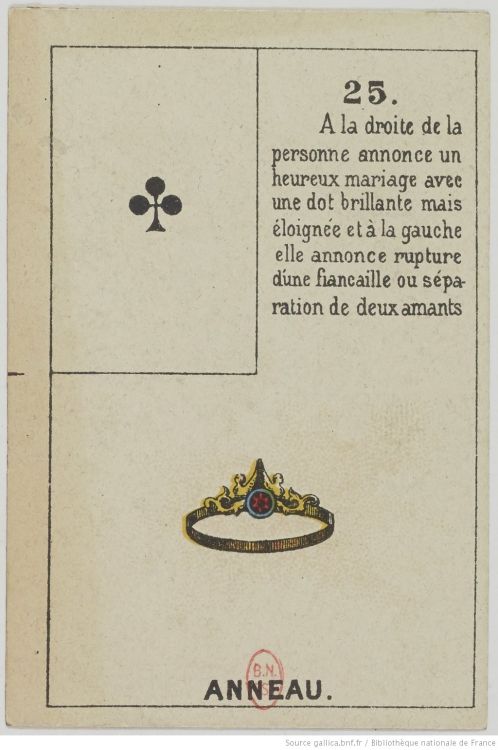
Card 25 - The Ring symbolizes the marriage and union between two people. Of course the concept must be extended to an alliance between several people, an agreement within a group, the signing of a contract, the creation of an association or a partnership. Of course the Ring can represent a jewel or a precious object. Attention, the card speaks of a lasting union and confirms the fidelity of the partners when it is to the right of the Significator (28 - Man or 29 - Woman), but it speaks of a rupture if it is to the left or far away.
The card is associated with the Ace of Clubs which stands for triumph and spiritual evolution.
The Ring is the card of promise and joining, and traditions agree on its base. The Russian tradition gives a solid reading: lasting bonds, contracts, deals, formal joining — a love bond or work partnership. It stresses the value of loyalty and staying true, and knows that breaking a deal or divorce can fit too based on context. The Brazilian tradition goes further in the thinking about bonds: how solid a union is rests on each keeping their word — if one fails, the tie weakens. It stresses staying together, being sound, fitting well with each other and the force that comes from union. In its shadow, the Brazilian tradition finds nuances the Russian tradition leaves unspoken: doing the same thing over, heavy duty or stuck in a promise that no longer helps. All traditions remind us that a bond's worth lies in its balance and giving back.
In the Gilded Lenormand version, the ring is set with gemstones, with a flash of light on the red stone, a ruby. Circles form the background of the image. In this form, the card does not seem to bring any new possible interpretations to the classical meaning.
I make the card of The Ring, the card of "link" and "connection". Naturally, I take up the whole of the classical interpretation, adding the following nuances:
In a multi-card draw, the Ring may indicate to the consultant to ally with someone. This person can be represented by a card juxtaposed to The Ring. But if The Ring is perceived negatively, this association with the neighbouring card must be broken. The Ring can also mean that two neighbouring cards must be married. Perhaps it is necessary to "kill two birds with one stone", to "combine the useful with the pleasant". In short, one must do two actions in one in order to optimise one's chances of success, to minimise the time spent, to be more efficient, etc. If the Ring speaks of an alliance that must be concluded, the nearby cards can evoke the points of blockage, or on the contrary the points of convergence. Thus, around the Ring, the cards can represent the pros and cons of the alliance at play. If the Ring speaks of an emotional or spiritual bond, a nearby card can symbolise the object of it (a memory, a place, a person, an event, etc.).

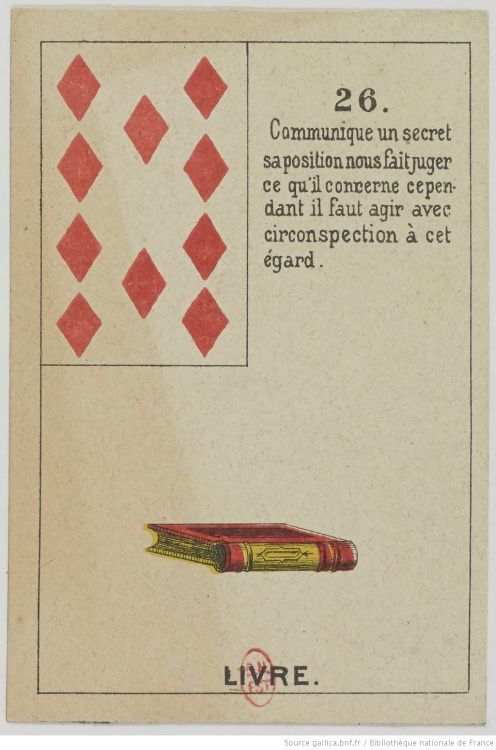
Card 26 - The Book is considered the card of secrets, mystery and esotericism. The Book can indicate that something essential is hidden from the view of the consultant or that he/she does not have the necessary height to see it. The book can also symbolise administrative procedures, intellectual occupations such as scientific research or studies punctuated by examinations. As the card is about secrets, it can also bring about revelation or awareness when the mystery is revealed and the truth comes to light.
The card is associated with the 10 of Diamonds, which symbolises travel, escape and encounters with foreign cultures.
The Book is the card of knowing and secrets, but European traditions add shades to what kind. The French school sees learning that is hidden or formal schooling; the German school puts weight on professional secrets and written proof; the Anglo-Saxon tradition stresses hidden truth waiting to be told, tying the card to pure mind. The Brazilian tradition brings these readings together and makes them richer: the Book means knowing held for those who know the code — language, skill — making it the card of the hidden and only for some. It adds memory kept alive and knowing that stays through time. The Russian tradition confirms: riddles, hidden data, chances to learn — and stresses that what is veiled can be very key if it came to light. In its shadow, all traditions agree: hiding and willful covering of truth.
The Book of Gilded Lenormand has ornaments such as cogs and a dial. Metal reinforcements and a hinge strengthen the book. A stack of books is visible in the background. The interpretation of the card remains classical.
I do not make the Book the card of secrets, but rather the card of knowledge. I do not evoke esoteric or mysterious meanings with this card, because divination is precisely the action of revealing what is hidden. It is up to the fortune teller to reveal what is secret to the consultant. So there should be no unsolved mystery with a good fortune teller !
Furthermore, I do not take into account the interpretations about the administrative procedures which are for me more symbolised by card 19 - The High Tower.
Speaking of knowledge in a general way, here are the possible interpretations :
The Book has a wide range of interpretation. The neighbouring cards can help to find its axis of interpretation. For example, if the consultant is looking for a training course, a nearby card can indicate the type of training. If it is a question of carrying out an investigation, the neighbouring cards can indicate the axes of research but also the difficult points or the assistance which one can benefit from. If the Book speaks of experience, wisdom, vision of the future, the neighbouring cards can again direct the reflection, by focusing on a memory, an idea, an abandoned wish, a bitter regret. If the point of view is reversed, the Book card can transmit its knowledge to another card. A juxtaposed card could be a brake because the consultant does not understand an aspect of the situation. The Book draws attention to this obscure point which must be clarified by knowledge and experience. The Book very often speaks of a knowledge, an experience, a truth that must be transmitted in one way or another in order to unblock the situation.

Card 27 - The Letter talks about messages that are given or received. This news can be good or bad depending on the neighbouring cards. It can also be a contract to sign, a form to fill out, or a document to write. In all cases, the Letter represents a need to communicate. Naturally, with the rise of the Internet, the Letter can symbolise emails, SMS or other instant messages, all forms of modern communication. In the strict interpretation the news is rather good, but if the Clouds are close, it becomes bad.
The card is associated with the 7 of Spades which indicates small annoyances or ephemeral conflicts.
The Letter is the card of written talk and data sent with a goal. The Russian tradition reads it very concretely: any important paper — deal, call to appear, notice, big message. The closer it is to the client's card, the more vital the papers in question. It can show a love note as well as an official warning. The Brazilian tradition adds a more symbolic side: the Letter shows data that goes from a sender to a set receiver, with a set path and a set goal. It also evokes bringing to light, turning outward, ads and forms from offices. Its life span is short — it loses worth once its goal is met. In its light, all traditions agree: talk that is clear and good news. In its shadow, the Brazilian tradition points to what the Russian tradition passes by: heavy bureaucracy, message that comes too late or shallow talk.
In the Gilded Lenormand version, the letter is taken out of its envelope and a feather is placed beside it. On the table are symbols and the names of the Little Lenormand cards. It is difficult to tell from the picture whether the letter has been received or whether it has just to be sent. In the case of a received letter, the fact that the envelope has been opened may mean that the news is as expected. That there are no real surprises.
Card 27 - The Letter is the card that gives me the most trouble in the Lenormand system. Indeed, I make card 12 - The Birds, the card of communication. Also the Letter covers the area of the Birds in terms of conversations and dialogues, even though one can consider that the Birds are more oral and the Letter more written. Then card 1 - The Rider speaks of the arrival of a message, as does the Letter. Then the Letter can speak of a document to be filled out in the case of an administrative procedure, but this can also be the domain of card 19 - The Tower, or even of card 26 - The Book. In short, in my opinion, card 27 - The Letter is partly or wholly redundant with cards 1 - The Rider, 12 - The Birds, 19 - The Tower, 26 - The Book. One may ask whether card 27 - The Letter is really useful ?
First of all we can remove card 27 - The Letter from the deck (yes, why not ? ^_^), and use only 35 cards instead of 36. However, this poses a problem when doing the "Grand Tableau" draw. Then, of course, you can keep it in the 36-card deck, and see the Letter as a duplicate card confirming the Rider, the Birds, the Tower or the Book, depending on the point of view adopted.
So I tend to make this card the "surprise" card rather than a "communication" card duplicating the Birds card.
Card 27 - The Letter speaks of a communication received or to be made. The neighbouring cards can therefore indicate the sender, the recipient, or the nature of the message. Generally the cards next to each other indicate whether the news is good or bad, as the Letter is rather neutral. If the Letter is perceived as a surprise, the neighbouring cards can indicate the nature of the surprise.

Card 28 - The Man represents the man, the consultant himself. If it is a female consultant, The Man will represent the lover, the husband, the father or simply a man in the entourage. Whatever the relationship between this man and the consultant, he is of particular importance to the question of the reading.
This card is associated with the Ace of Hearts, speaking of family and home.
The Man is the card of the male figure in the draw, and traditions agree on how it works. For a male client, it shows him straight; for a female client, it names a man who is there and has power in the situation. The Russian tradition makes clear the kind of link: husband, father, son, lover — and shows that where the Man card sits next to the Woman card in the draw tells you about the strength and kind of bond between the two. It adds the chance of deep shift or a big role played by this man. The Brazilian tradition makes the picture richer by giving it a wider symbolic side: active force, doing, choice, leading. It stresses that how good or bad this figure is rests fully on the cards next to it, and asks you to be the lead in your own life. In its shadow: staying rigid, too much self, or ruling too hard.
In the Gilded Lenormand, the card comes in two versions. The first card shows a bearded man sitting on a high iron chair with a red rose in his hand. A window surrounded by two columns is behind him. The second card shows a bearded man with long hair, his shirt half-open over his rather muscular torso. He is wearing a necklace with the male symbol. The fact that the deck comes with two No. 28 cards allows the "Grand Tableau" draw to be made with two Man cards instead of one Man and one Woman card. This makes the gay love draw more consistent.
Honestly, the Man card is only really useful in the love draw of the "Grand Tableau". In a classic draw of 3 to 7 or more cards, the presence of the Man can indeed mean the intervention of a man. But if the draw is about a financial or other matter, the Man card may have very little meaning.
Also, I like to see this card as the "Mirror" card of the consultant if he is a man. As if the consultant is looking in the mirror. What emotion is in him ? Is he asking himself the right questions ? Is he able to look himself straight in the eye, to confront his own image ? In short, this is an introspective card.
If the consultant is a woman, the card may evoke the masculine aspects of her personality. Does she show initiative? Is she a fighter ? Perhaps she is even too much of a warrior ? Is she protective ? Perhaps too much of a mother hen ? Can she speak with aplomb ? Or is she too bossy ? Is she assertive, cool-headed ? Again, this is an invitation to introspection.
If one takes the classical interpretation of the card, it has little added value. It is therefore necessary to look for additional information in the neighbouring cards. If the evocation of a man is validated, the neighbouring cards will specify his personality or even his identity. Otherwise, the Man card is so neutral and empty, don't take it into account. Unless, like me, you see it as an introspective card, in which case, ask the consultant more questions. Look for a "mirror" effect or a "male" aspect, the source of the problem or, on the contrary, the solution to the problem.

Like the Man, the card 29 - The Woman represents the woman, the consultant herself. If it is a consultant, the Woman will represent the lover, the wife, the mother or simply a woman in the entourage. Whatever the relationship between this woman and the consultant, she is of particular importance to the question of the draw.
This card is associated with the Ace of Spades, which is a very bad omen. In fortune-telling it is the most negative card in the deck.
The Woman is the card of the female figure in the draw, and works in the same way as the Man card. The Russian tradition gives a clean reading that mirrors the Man: it names the female client if she is a woman, or a female figure close by — wife, mother, daughter, lover — if the client is a man. Where it sits next to the Man card shows the bond between the two. The Brazilian tradition adds a symbolic side of its own: the Woman shows intuition, the ability to take in, presence and female lead as a guiding force. It stresses that what it means grows based on the cards next to it, and that in its light, it shows warmth, sharp sight, teamwork and the gift of welcoming. In its shadow — unique to the Brazilian tradition —, it can show doubt, envy, moving others or slowness that blocks needed action.
In the Gilded Lenormand, the card comes in two versions. The first card shows a pensive young woman leaning over a book, holding a red rose in her hand. A window is behind her. The second card shows a young woman with long hair and make-up looking out of a window. Loose clothing opens over her bare chest. She is wearing a necklace with the female symbol. The fact that the deck comes with two No. 29 cards makes it possible to do the "Grand Tableau" draw with two Woman cards instead of one Man and one Woman card. This makes the lesbian love draw more consistent.
I have the same opinion as for the Man card, i.e. the Woman card is only really useful in the love draw of the "Grand Tableau". In a classic draw of 3 to 7 or more cards, the presence of the Woman can indicate the intervention of a woman. But if the draw is about a financial or other matter, the Woman card may be meaningless.
As with The Man card, I like to think of this card as the consultant's "mirror" card if she is a woman. As if the consultant is looking in the mirror. What question, what emotion comes up in her? Is she able to face her own gaze and accept her own image? In short, this is an introspection card.
If the consultant is a man, the card may evoke the feminine aspects of his personality. Is he receptive? Is he sufficiently attentive to others ? Perhaps he is too sensitive or emotional ? Is he stingy, not generous enough ? Or on the contrary, is he too generous, too kind ? Does he lack confidence? Is he or she moody ? Above all, it is an invitation to introspection.
If we take the classical interpretation of the card, the Woman can bring little information to the draw. Often, it is useful to complete the interpretation thanks to the neighbouring cards. If the evocation of a woman is validated, the nearby cards will clarify her personality or even her identity. If not, the Woman card is so neutral and empty that it should not be taken into account. Unless, like me, you see it as an introspective card, in which case, ask the consultant more questions. Look for a "mirror" effect or a "feminine" aspect that might be the source of the problem or perhaps its solution.

Card 30 - The Lily symbolises purity, loyalty and to a lesser extent royalty (hence nobility and prestige). If the Lily represents a person then that person will be a good judge, fair, honest and sincere. Serious and dedicated, they will be capable of real support or protection. The Lily is therefore a sign of a person who can be trusted. Otherwise the Lily brings light, peace and happiness. The card also brings a certain amount of glory, making social advancement possible. In the strict interpretation, if the card is close then it is positive and speaks of a happy life, but beware if it is close to the Clouds or below the Significator (28 - The Man or 29 - The Woman) it becomes negative.
The Lily is associated with the King of Spades who is an austere man, working in intellectual professions such as medicine or law. He is a man of nobility and inspires respect.
The Lilies are perhaps the most fought over card between traditions, above all in European schools. In France, it brings peace, harmony, maturity and purity — at times the care of an older man like a father or wise friend. In Germany, in the modern way of Iris Treppner, it swings toward sex drive, desire and bodily passion. The Anglo-Saxon tradition sees know-how, wisdom, long life and goodness. This fight makes readings that are opposites: Lilies + Heart is a calm and pure bond for a French reader, a sexually hot bond for a German one. The Brazilian tradition offers a balanced synthesis: purity, noble soul, gifts you are born with and natural beauty, but also refined closeness and peaceful intimacy. The Russian tradition backs the good and high side: goodness, social rank, long life, a helper near. In its shadow, all traditions agree on the risk of sameness or coldness.
In the Gilded Lenormand version, the card shows 6 fleur-de-lis, 3 white and 3 purple. Behind it, an Art Deco stained glass window gives off a soft light. In its style, the card remains within the framework of the classical interpretation without extending it.
I am not very comfortable with this card, because like card 27 - The Letter, I find it redundant with other cards in the Lenormand system. Indeed, the symbol of purity and loyalty of the Lily can overlap with the symbol of innocence, trust and sincerity of card 13 - The Child. Similarly, card 2 - The Clover speaks of a form of protection which can also be found in the Lily. We can also mention the card 9 - The Bouquet, which speaks of benevolence and which can be totally in line with the meaning of loyalty and nobility present in the Lily. The Lily can also bring the same calm and serenity as the card 16 - The Stars. Finally, the Lily can also speak of a dream of social ascension, of prestige, just like the card 20 - The Garden.
Moreover, I can understand that at the time of the creation of the Lenormand system, social elevation, prestige, glory were perhaps more desired values. Today, however, people would rather want personal well-being, fulfilment at work, stability and sustainability of the social circle. Therefore, the Lily seems to have less reason to be in the game than other cards such as the Child, the Bouquet or the Clover with similar interpretations.
Also with the Lily, I tend to leave the values of purity to the Child, nobility and prestige to the Garden (although the Lily is the emblem of French royalty). I can keep the notions of righteousness and loyalty which do not seem to be embodied by any other card. Last but not least, I opt for a modern yet classical interpretation of the lily, as an almost religious flower (since it is usually associated with the Virgin Mary) and therefore of fertility. If fertility can also be perceived through card 17 - The Stork, religious faith is absent from the standard interpretation even through card 36 - The Cross. So to summarise, although you can keep the keywords Purity, Nobility, Prestige about the Lily, you can focus on :
The Lily card signifies a person who is behaving in the right way, moving in the right direction within a healthy and serene situation. Also the neighbouring cards will capture this positivity and should be read as favourable or at least moving in the right direction, even if these cards seem negative at first sight. As if an evil was necessary for a good. As if failure would lead to success sooner or later. Another view is to see the Lily card as a questioning of the consultant's inner and deep values, while the cards nearby will speak of the surface of things, of immediate actions and words. In this way, the Lily can raise the level of moral debate proposed by the other cards, and encourage one to take a step back, to put into perspective the agitation of the present time.

Card 31 - The Sun is the card of radiance, light, optimism, charisma. The card instills a powerful energy, a feeling of life, a joyful emotion, a sense of well-being. The Sun chases away clouds, removes problems, eliminates worries. It is a protective card that mitigates negative cards. If the Sun represents a person, he or she will be charismatic, popular, even famous, showing magnetism, but he or she can also be too extroverted, inconstant.In the strict interpretation, the Sun brings happiness but is disturbed by the proximity of the Clouds.
The card is associated with the Ace of Diamonds which is a card of achievement. In classical fortune-telling, the card also speaks favourably of the business world.
The Sun is one of the most favorable cards in the game, and traditions share this view fully. The Russian tradition makes it a sign of shining success: luck, happiness, wishes coming true, fame and being known well. It stresses its power to lift up — it strengthens good cards nearby and softens bad ones — and can show the end of a hard time and return to a happy life. The Brazilian tradition adds a deeper thinking: the Sun shines openly, shows truth for anyone who wants to see, and means the energy of growth — gold, royalty, big luck. It also shows trust in yourself and personal shine: knowing your own worth and daring to take the place that is yours. In its shadow — unique to the Brazilian tradition —, it can point to caring too much about yourself, pride or a bright light that blinds and burns.
In the Gilded Lenormand, the card shows a sun with a golden face, as in the Tarot de Marseille. The multiple rays go in all directions. Below the face is a sundial with the hours, the shadow points to the number 6. In this deck, the Sun is a card of triumph, of a moment of glory, drawing the admiration of all.
The Sun card can be a problem in the Lenormand system because of the range of meanings of the sun symbol. This problem also exists with the 24 - Heart and 32 - Moon cards, which offer a wide range of interpretations, where the system is intended to be simple, effective and unambiguous. So, as with the Heart and the Moon, with the Sun you have to know what you are holding on to as a meaning.
For my part, I do not retain the values of happiness and success of the classical interpretation of the Sun, because they are already conveyed by the cards 2 - The Clover, 9 - The Bouquet, 16 - The Stars. I therefore stick to a traditional symbolism of the Sun which is concerned with radiance, optimism and achievement. But very clearly with the symbol of the sun, we could also speak of vitality, individuality, power to act and to emancipate, fertility, growth and development, light and energy.
Like the Lily, the Sun tends to radiate onto neighbouring cards. Negative cards see their effect diminished. The energy of the Sun unblocks situations, moves projects forward, brings contracts to fruition, and makes meetings happen. In general, the Sun brings to life what should be (positive) in the other cards. The Sun tends to be in the centre of the draw, and not a satellite of a nearby card. However, the Sun can be faulted, and a juxtaposed card can introduce a weakness in the Sun that will nuance or even counteract its interpretation. In astronomy, the sun is said to have dark spots, and neighbouring cards can represent them.

Card 32 - The Moon has a rather special meaning in the Lenormand tradition. The card speaks of the light of others that is reflected, as the moon reflects the light of the sun. Thus the Lenormand Moon evokes recognition, honours, notoriety. When it is far away, it speaks of disappointment, sadness or even misfortune.
Many cartomancers extend the field of interpretation of the Moon to its usual symbolism, which I detail in the section 'my interpretation' below.
The card is associated with the 8 of Hearts which brings joy and care to the consultant.
The Moon is a card read very differently across traditions. In the European school, the split is clear: in France, it calls to mind feelings, inner knowing, fancy and dreams; in Germany, it means career, social success, honors and public recognition — the German 'wins' under the Moon, the Frenchman 'dreams'. The Anglo-Saxon tradition sits between: inner knowing, the under-mind, fame and draw. The Brazilian tradition brings an original and uniting reading: the Lenormand Moon is a 'maker', giving real form to our desires, pleas and fears by making them bigger — hence its link to fame and impact on those around us. It adds the gift of feeling others' thoughts and life cycles. The Russian tradition backs its general good nature, while stressing the need to look inward and step back to move ahead better. In its shadow, all traditions turn toward trick and emotional swinging.
In the Gilded Lenormand, the Moon is waxing with a face, just like the Sun. The picture also shows the different phases of the Moon, and underneath, what might look like an astrolabe. The author goes beyond the standard meaning about the Moon. He sees it as a card of love, romance, intuition, imagination and creativity. But he also warns that its sphere of influence is even greater. He also talks about cycles, water, and emotions.
I am therefore not the first to modify the basic meaning of the Moon, as it is true that honours and notoriety are not usually associated with the star of the night. Moreover, these two values could cover the field of interpretation of the cards 16 - The Stars, 20 - The Garden or 30 - The Lily, which deal with the notions of grandeur and prestige.
The moon has a vast symbolism perhaps even wider than that of the sun, due to its changing appearance. As a reminder, the moon usually symbolises: femininity, fertility, the menstrual cycle, the mother, dreams, imagination, illusion, intuition, spirituality, the unconscious, sensitivity, emotionality, shadows and mystery, nostalgia and melancholy.
You can of course use such a wide field of interpretation, but you may get lost in your reading. For my part, I do not retain the notions of femininity, fertility, spirituality that I connect more with the Lily card. Emotionality, melancholy, shadows can be represented by card 6 - The Clouds. Nostalgia can be carried by card 13 - The Child. Mystery can be embodied in card 26 - The Book. Dreaming can be seen in card 16 - The Stars, probably also imagination and illusion. Finally the values of the Moon are already induced by some cards. Also, with the Moon of the Lenormand, I usually focus on sensitivity, intuition, the unconscious which remains the essence of the symbolism of the star of the night.
If the Moon comes out in the draw, you can ask the consultant how he/she perceives the situation. The neighbouring cards may not reveal what he/she already understands or knows, but more about repressed aspects, buried emotions, latent feelings. There is what the consultant thinks he/she is, and what he/she really is. The Moon is there to warn of the difference between the perception of one's interiority and the reality of one's interiority. In fact, the dialogue about the cards next to the Moon is very important, because the consultant might think that the fortune teller is following a false direction, whereas this is not the case. It is therefore relevant to review the juxtaposed cards of the Moon through the prism of interiority or even the lunar symbols mentioned above. The Moon can spread its attributes to the nearby cards: a cyclical frequency of the phenomenon, a lunatic character, an illusory aspect, an emotional or irrational fear on a specific subject.

Card 33 - The Key is naturally one of the easiest cards to understand. Because the key opens a closed door, the card indicates success, the solution to the problem if it is close. If it is far away, on the contrary, the Key announces failure.
The card is associated with the 8 of diamonds which is a good sign for travel or work.
The Key is the card of answers, openings and free will, and traditions share a common positive base. The Russian tradition is direct: a good choice, the right way, the answer waited for and freeing a hard situation. It shows the client is about to step into a new phase. Ringed by bad cards though, it can instead show doors shut, a poor choice or delay in moving ahead. The Brazilian tradition adds a deeper thinking side: the Key shows free will itself — it is the hand that holds it that chooses if it opens or closes, joins or parts. It stresses human duty in freeing up situations, and spreads the symbolic field to pass-codes, safe secrets and gates to other worlds. In its shadow, the Brazilian tradition adds a warning missing from the Russian reading: waiting too much for magic answers or a sure thing that ignores the real world's complex shades.
The Gilded Lenormand Key has an intricate bit, its ring is set with precious stones. Behind it is an open birdcage. Inside is a red rose. The author is thus evoking a solution or success that may be complex to find and therefore difficult to implement. The cage and the rose undoubtedly evoke the release of a desire, made possible by the key.
Beyond an announced success or the release from a closed situation or a hold, the key could speak :
The Key can mean that one of its neighbouring cards will tip over, become free, find a favourable outcome. If there are several negative cards around the Key, I don't believe that the Key will resolve all the cards. Perhaps it is necessary to find the negative card that will benefit from the liberating power of the Key. One of the juxtaposed cards in the Key could be the solution the consultant is looking for. Another card close by could represent what is locked up and deserves to be released.

Card 34 - The Fish is related to work and money. It heralds a miraculous catch, success in business and in all enterprises. The Fish can also represent places like the sea, rivers. If the card is far away, as is often the case, it becomes a bad omen, and speaks of misfortune.
The card is associated with the King of Diamonds representing a skilful and competent person, a true entrepreneur.
The Fish are the card of plenty and riches, and traditions agree on their giving spirit. The Russian tradition says the client's wishes are about to come real, often more than hoped: money, pay, material winning, new ideas and a happy end to a deal. Ringed by bad cards, it points to plans that are not real or choosing poor partners. The Brazilian tradition brings a strong symbolic source, missing from the Russian reading: inspired by the Bible story of bread and fish multiplying, the card shows plenty that grows when it moves freely. It also spreads far past stuff: feelings, gifts and talents grow in motion and trade. In its shadow, the Brazilian tradition finds risks the Russian tradition leaves unspoken: hunger for more, spending wild or money trouble from lack of care.
In the Gilded Lenormand, the image shows 3 carp at the bottom of a river covered in algae. A ray of light shines through the water. The card does not seem to provide any additional insight to the standard interpretation.
The Fish may speak of a big catch and mean a bountiful catch. But this good fortune is undoubtedly an unhoped-for chance, as we all know, we never know in advance what will take the bait. In the end, this success seems rather random and not necessarily linked to judicious choices, real skills, or hard work. In this respect, I find that the Fish is really close to card 2 - The Clover, they are almost a duplicate card. I would probably have preferred a symbol like the pig (with a piggy bank for example) to widen the possibilities of interpretation.
We can still suggest, because fish live below the surface of the water, that the card may represent activity, a disturbance below the surface of appearances such as bribes, secrets, unofficial information, etc. But again, with such interpretations, we are closer to card 26 - The Book.
The fish is also an animal that slips through the water, it is very difficult to catch it with bare hands because the fish slip out of the hands thanks to their scales. This card can be used to refer to a situation that is slipping out of the consultant's hands: his money, his lover, his time, etc.
Finally, Water is the symbol of tears, of emotions. It is possible to propose interpretations in this sense, to evoke the emotional state of the consultant.
In combination with other cards, The Fish can naturally convey their good fortune, and reverse apparently negative cards. The Fish can also randomise the effects of juxtaposed cards, or render them invisible at first impression, but well and truly existing, merely concealed by deceptive appearances. The Fish can totally negate the effects of a nearby card, like breaking your line, or like the landing net coming out of empty water. Conversely, the Fish's successful but hazardous fishing may be confirmed or denied by a nearby card.

Card 35 - The Anchor speaks of successful ventures in the business world and of fidelity in love. It is therefore a happy card. The Anchor can also naturally represent stability, the security of a situation. Away from it, the Anchor is the opposite, meaning an unhappy business and an unfaithful love.
The card is associated with the 9 of Spades which is a particularly negative card in fortune-telling. Between the classic 52-card deck and the Lenormand system, we are never far from a contradiction.
The Anchor is the card of steady ground, trust and hope held firm, and traditions meet on its basically good nature. The Russian tradition is firm: it is always a good card, no matter what is around it — solid bonds, safety, care, staying true and trust. It ties to work and all that lasts. Badly ringed or far from the client, it can signal lightness or shaky faith. The Brazilian tradition goes deeper with sea and spirit signs: the Anchor is the safe port that holds the ship in storms, and in Christian signs, it shows hope and belief — the firm faith that aid will come back. It means staying true, holding firm and lasting work. In its shadow — unique to the Brazilian tradition —, it can show staying still by holding too tight to what is known, or mixing steady ground with not moving: the time to lift the anchor and go forward.
The Gilded Lenormand Anchor floats on the waters of the sea. Two carved fish adorn the two arms of the anchor. Several seagulls fly over the anchor while clouds fill the sky. The threatening storm is a reminder that the Anchor is a strong object that can withstand the elements. The fish are linked to the card of the same name. So for the author the Anchor is also a symbol of abundance and wealth, although I don't fully understand why. Especially since he adds that in the Lenormand tradition this card also conveys hope and faith (as opposed to card 36 - The Cross which follows).
The Anchor is solidly made, so it evokes a safe, secure situation in the face of a difficult and exhausting trial. We can also add that the card could speak of a form of resilience or possibly a fighting spirit. In any case, it is of course synonymous with an anchoring, a deep centring that nothing seems to destabilise. It can also be seen as a call for calm and patience.
This anchoring therefore evokes a powerful force that holds things in place and together. So much so, that one could not get rid of it, could not get out of it. In such a case, the card could speak of an Anchor which becomes a kind of ball and chain, holding the consultant back or even holding him/her back. He/she could be immobilised by a dead weight.
This brings us to a very interesting interpretation of this card, which is the notion of attachment. The Anchor could therefore represent a bond so strong that it becomes a constraint, handcuffs preventing one from leading one's life with freedom and agility. The Anchor can therefore invite detachment. At some point, should we not lift the anchor and cast off ?
Finally, the anchor may recall the shape of the double hook. Isn't there something that irresistibly attracts the consultant? Hasn't he/she been hooked, trapped by something, by someone ?
In association with other cards, the Anchor can bring them together, making them solid and linked when these cards seem to oppose each other. The Anchor can thus be the center of the draw and consolidate it. One of the most interesting aspects is to guess the link that unites all the cards in the draw. On the other hand, the Anchor can invite the consultant to cut a link instead of establishing one. Also, it is necessary to get rid of a neighboring card that acts as a weight for the consultant. If he/she is in trouble, the Anchor acts as a reinforcement and assures that he/she must hold on. The neighboring cards can describe the trials in progress, but also indicate means and solutions to not give up and survive the storm.

Card 36 - The Cross announces the end of an era, of a happy period, it announces sadness, grief, torment. As always, its effect depends on its distance. The closer the Cross is, the shorter its negative effect will be.
The card is associated with the 6 of Clubs which speaks of a solution to a problem or adversity. It announces a small joy, recognition or admiration.
The Cross is the hardest card in the game, and traditions agree on how grave it is. The Russian tradition is clear: it always warns of something painful, no matter where it sits — a heavy load, deep hurt, a trial that is fated or sacrifice made for a higher good. It links to the 12th card of Tarot, the Hanged One, and reminds us some trials are part of the path and cannot be escaped. The Brazilian tradition shares this finding but sets it in a richer spiritual and changing frame: the Cross shows a life process that goes past our regular power and pushes us toward a higher strength. It shows the scars that extreme situations leave in us that change us deeply. But it also holds the promise of healing: after pain comes relief. In its shadow, the Brazilian tradition warns of playing the victim, giving up without a fight or a burden one will not set down.
The Gilded Lenormand cross is made of wood and has two images of Christ and the Virgin Mary. Behind it are the stained glass windows of a church through which the sun's rays shine. The image gives off a positive mood, whereas the booklet describes a card that is in line with the standard interpretation, i.e. rather negative.
The Cross is one of the cards with which I disagree the most regarding its interpretation. My first impression would have been that the Cross is a symbol of faith, fervour, spirituality, blessing, and therefore a rather positive symbol. It seems that originally, the passages of the way of the cross of Christ and his suffering on the cross were used to establish the symbolism of the card. However, the Lenormand system already has the card 8 - The Coffin, the card 11 - The Whip, which can be related to the notions of end and suffering. Certainly the Whip speaks more of conflict and strife rather than a kind of flogging or enduring of suffering. So the additional interpretations I offer below, which are in contradiction with the standard view, are for you to judge if they can be useful to you anyway :
Depending on whether you make the Cross a negative card of suffering or a positive card of fervour, its interaction with neighbouring cards will of course be profoundly altered. Because the Cross remains a religious symbol, the card tends to be the central or pivotal card in the draw. The Cross shapes minds, sets standards, and judges what is good and bad. Also within a draw, the Cross can indicate that next to it there is a good card, a bad card, a blessed card, a redemption card, a suffering card. Think of the Cross as a vindictive priest who, in the midst of his disciples, would distribute good points and bad points. Thus card 36 - The Cross judges the other cards around it or perhaps forgives.
Keywords for the 36 cards of the Petit Lenormand, to slip into your favorite deck. Your leaflet always with you, at hand, to guide you in your readings. Thanks to it, your interpretations gain in richness and subtlety.
The simplicity of the Lenormand cards can be deceptive. Following the classical interpretation of the cards, I think that beginners should still do some real learning of the Lenormand system to produce solid and consistent readings.
I hope that with the personal elements I propose for each of the cards, this progression will be facilitated. Feel free to comment and share your own vision of the cards.
Each card in the (Petit) Lenormand is a universe of symbols and meanings that intertwine with our own stories. Your personal interpretation enriches the fabric of our collective understanding. Which card resonates the most with you? Do you have a story or a personal interpretation that could shed new light on the mysteries of the (Petit) Lenormand?
I invite you to share your discoveries and stories in the comments below. Your contribution is valuable and can become a beacon for someone else on their path of discovery.
Copyright © www.tarotquest.co